We can't find the internet
Attempting to reconnect
Something went wrong!
Hang in there while we get back on track

Porto's culinary record
Porto’s homegrown cooking continues to survive in a way that mirrors the image of the river Douro that runs through the city: certain of its origins and (almost always) faithful to its path. There are certainly obstacles in the way, from flashy culinary trends to unbridled tourism, but traditional cuisine continues to flow forth, helped along by the fact that offering the “authentic” has become good business. The recipe for long-term success still remains elusive, for both the most old-school spots and the most gourmet chefs, and the city is still looking for the balance between staying true to tradition and opening the door to a new world of gastronomy. But we tripeiros will continue to have a stomach, as the Portuguese expression goes, for these changes, as long as there are still places for restaurants to open and affordable (and maybe even finger-soiling) meals to be had.
Get the Full Story →Tour Porto with Culinary Backstreets®


discover the city, street by street, bite by bite
Porto
Guindalense FC: Where It’s Always Festival Time
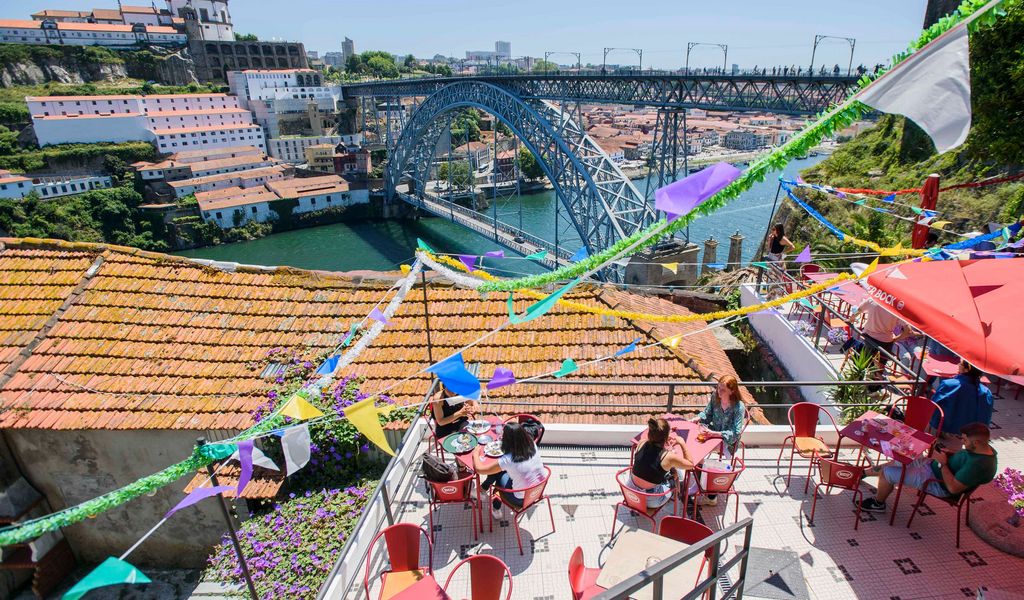
Those returning to Porto along the Luís I Bridge will notice a set of terraces to their right decorated with colored garlands, flags and string lights, as if someone forgot to take down their decorations after the June 23 São João festival, the city’s largest celebration. The garlands and flags stay up all year, though, and are the easiest way to find one of Porto’s most interesting hidden gems: the Guindalense Futebol Clube, home to some of the city’s best views. The story begins, at least officially, in 1976, when the club was founded as a place for amateur footballers and other athletes in the Guindais neighborhood.
Read more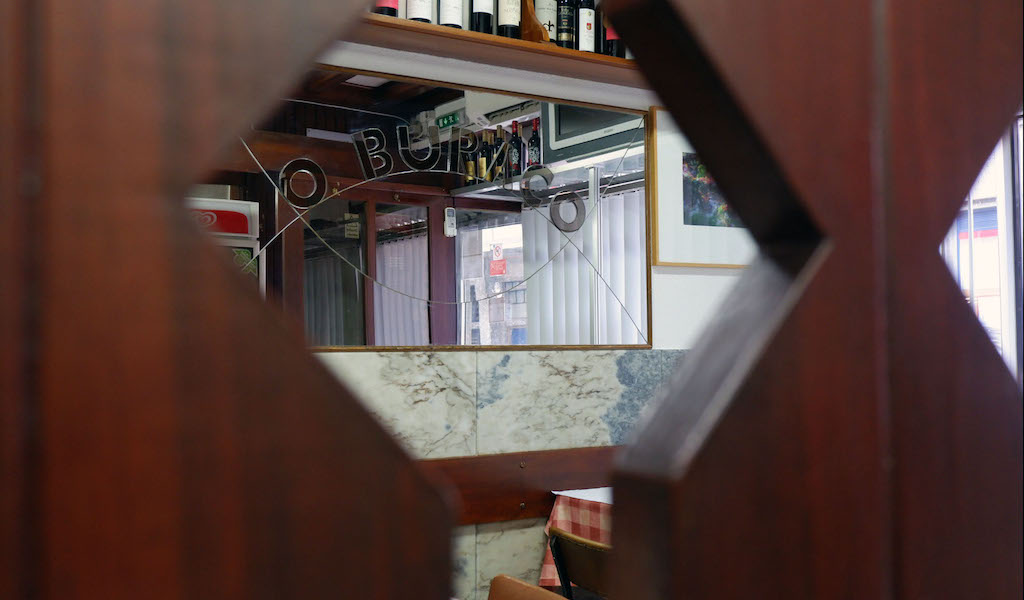
Porto
O Buraco: In the Trenches
Manuel Azevedo and Francisco Moreira, now both in their 70s, have been friends since childhood. Such a close connection has afforded them the trust and togetherness required to run O Buraco, the restaurant in Porto that the duo have presided over like generals for almost 50 years. In fact, it was right after completing his military service that Manuel, a native of Marco de Canaveses, a city within the greater Porto municipality, came to Porto proper in search of work. “I picked up the newspaper, saw the ad, applied and was hired as a waiter,” he tells us. On February 4, 1971, he entered O Buraco (“The Hole” for the first time; he hasn’t left since.
Read more
Porto
Casa Nanda: New Look for a Classic Kitchen
More than forty years ago, on the corner of Porto’s Rua da Alegria, or “Street of Joy,” sat an old charcoal shop. In 1978, after many years working in a renowned local restaurant, Fernanda (Nanda) Sousa took over the shop with her husband and, together with another couple, they converted it into what’s locally known as a “pastoral house.” With barrels of wine scattered about and ham hocks hanging from the ceiling, it was the quality of the food, not the interior, that elevated Casa Nanda to restaurant status. Now, 40 years on and having stared Covid-19 down, Casa Nanda has reopened on Rua da Alegria after a months-long renovation.
Read more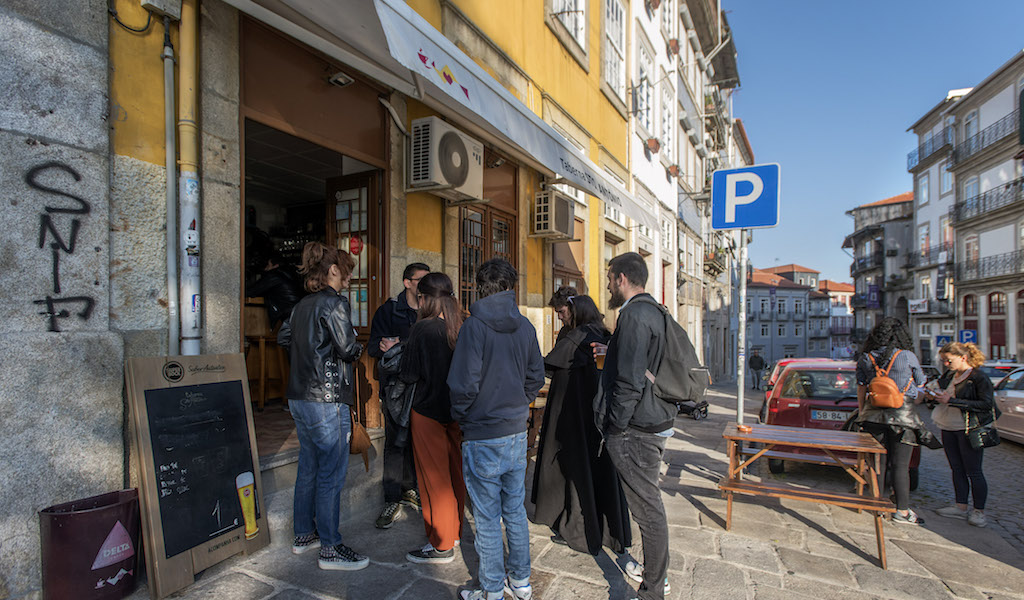
Porto
Taberna Santo António: A Virtuous Corner
We arrived at Taberna Santo António after lunch, looking for a bit of warmth in the middle of winter. It wasn’t a shot in the dark – we already knew that we would be enveloped by a comforting hospitality at this classic Porto spot. The sun was shining, so we sat on the terrace with Pedro Brás, whose parents own Taberna Santo António. “We’ve been here for 30 years in March,” he said. And while nowadays the surrounding landscape is inviting – just around the corner is the Parque das Virtudes, where crowds congregate in the late afternoon to listen to music, chat and drink beer as the sun sets over the Douro River – that was not always the case.
Read more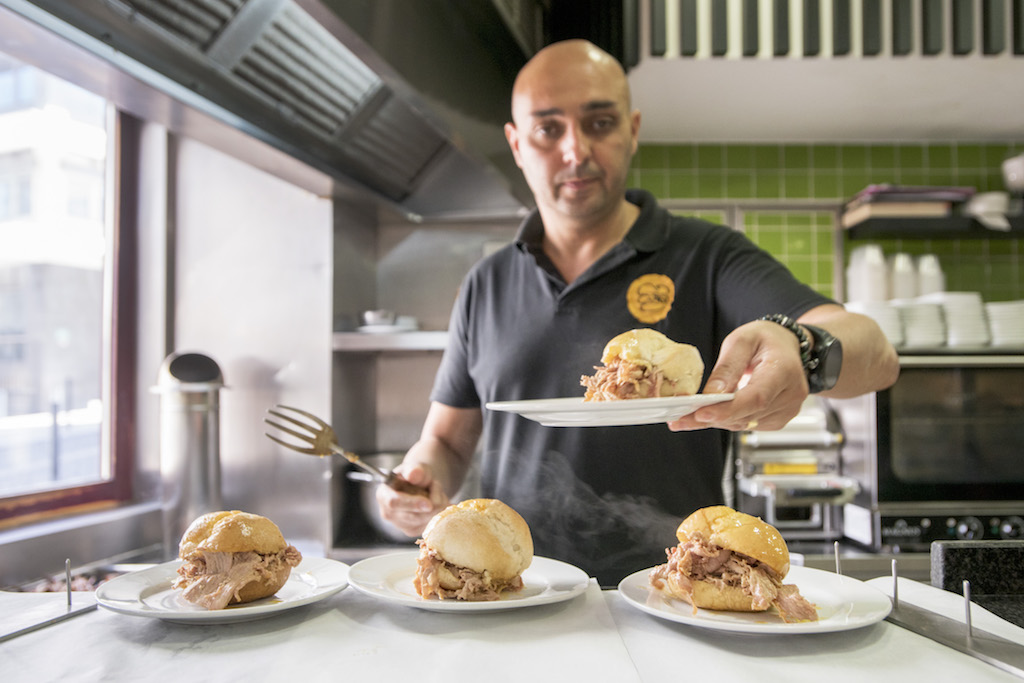
Porto
Conga: On A Roll
You would think Sérgio Oliveira, the owner of Conga in Porto and the secret-keeper of its legendary recipe for bifanas, would be tired of the restaurant’s signature dish. But you’d be wrong. “As much as I try not to eat it, I cannot. It is impossible,” he says. "One always eats it; there is no chance not to.” It’s a simple but addictive dish. Pork, cooked all day in a mysterious spicy sauce and stuffed into a piece of bread that looks a bit like a roll– at first glance, it does not seem to impress. But Porto continues to hide the best and tastiest of its secrets in the simplest things in life.
Read more
Porto
Rogério do Redondo: Old and Improved
We went looking for Rogério Sá at his usual spot – his restaurant, Rogério do Redondo – but we were told at the counter that he just went “down there” to get “something” and will be back in a minute. “Down there” is with the men who fish in the Douro River. “Something” turned out to be shad – two fine specimens of the fish, in fact. “It’s in season,” Rogério tells us when he arrives. We know that fresh fish is worth the wait. The phone rings as we’re talking to Rogério, and he picks up. It’s someone calling for reservations – a party of six, and they’d like to pre-order the classic dish of rooster cabidela (where the meat is cooked in its own blood). “Let me talk to the cook to see if there’s any available, and I’ll call you back,” he says.
Read more
Porto
A Cozinha do Manel: Less is More
The sensation of entering A Cozinha do Manel (“Manel’s Kitchen”) in Porto is so similar to entering grandma’s house on Sunday that it almost confuses us. There is no one to greet you at the door, no cloth napkins folded over employees’ arms. We walk confidently, as we would at home, with the sense of comfort that only intimacy is capable of inspiring. From the wall, among the many clocks, vintage plates and drawings made on cloth napkins by customers with an artistic bent, dozens of familiar faces look back at us. They are actors, musicians, politicians and soccer stars all standing next to Zé António, the owner and manager – a confirmation of the restaurant’s popularity.
Read more


Daily Dispatches from the Frontlines of Porto



Get Your Free Porto Pocket Guide
Introducing our pocket-sized Porto guide — perfect for your next culinary adventure. Yours free when you sign up for our newsletter.
Get Your Free Porto Pocket Guide
Introducing our pocket-sized Porto guide — perfect for your next culinary adventure. Yours free when you sign up for our newsletter.
Immersive Multi-Day Journeys In and Around the World’s Culinary Capitals



Your trips, powered by our picks
Curated Porto Travel Boards


Visual Dispatches from the Frontlines of Local Eating
Discover the Culinary Backstreets of Porto
Culinary Backstreets® Envoys, Always Searching for the Next Hidden Gem

Carine
Porto Tour Leader

Bruno
Porto Tour Leader

Marta
Porto Tour Leader

Mariana
Porto Tour Leader

Marcel
Porto Tour Leader

Maria
Porto Tour Leader

Magalie
Porto Tour Leader

Ricardo
Food Tour Leader

Rafael
Porto Correspondent

Cláudia
Porto Correspondent

Ricardo
Porto Photographer
Your Questions, Answered
Porto is deeper into Portuguese tradition and more compact, Lisbon has more variety and immigrant scenes. Do both.
Three days. One for Ribeira and downtown (Bolhão market, francesinha at Café Santiago), one for Cedofeita and Foz do Douro (modern Porto dining, seafood at the beach), one for a Douro Valley wine trip.
Porto is the second largest city in Portugal, located on the northern coast of the country. It sits on the banks of the Douro River, extending to the Atlantic Ocean, where the river empties. It is considered the “capital of the North” and it is close to the Douro Valley region (to the east) and the Minho region (to the north).
While Porto is a good base for a daytrip to the Douro Valley, the city makes for a diverting stay, with beautiful museums, palaces and cathedrals. Eat at a local tasca (homestyle restaurant), watch the sunset over the river, order fresh grilled fish (or a Francesinha!) and grab a cable car to Gaia.
The best time to visit the city is the month of June, when the most important celebration takes place: São João or Saint John’s Festival. It is a city-wide event that lasts the entire night of June 23rd, into June 24th. The weeks leading up to the holiday are filled with activities as well, and the city is full of decorations as well as folks grilling sardines. In June, the weather is usually warm (but not too hot), and the days are longer. We also have several big events around this time, like the Primavera Sound music festival, the FITEI theater festival and the Serralves em Festa arts/music festival. Other good times to visit, especially for milder weather, are spring/early summer, as well as September/mid-October.
Generally, the climate in Porto is moderate, influenced by the proximity of the Atlantic. Summers are usually pleasant and mild. Most days never get too hot, around 78 F, though on the rare occasion temperatures can hit 100 F.In winter, temperatures rarely drop below 40 and maximum temperatures hover around 57. It almost never snows – the last (small!) snowfall was almost 20 years ago, but it does rain a lot. In spring/fall months, the weather can be very unstable. Locals know to check the forecast before leaving the house, to always dress in layers, and prepare for “several seasons in a day.” Warm days are more common in May/June and September, but windy periods, drizzly mornings and chilly nights are not rare. Rain is a part of life in Porto, sometimes gracing us even in the summer (albeit usually weak and lasting for short periods of the day). However, if you are coming during winter or in wetter months (like April and November), we recommend a raincoat and shoes fit for our (wet) steep cobblestone streets.
Prices in Porto are lower compared to the United States and Central Europe.A café (espresso) costs less than $1, a glass of local beer is around $1-2, and you can have a nice, mid-range dinner for around $15-20 person. However, prices can be significantly higher in touristic areas and restaurants, so check out our Porto archive to find the best local tips.
Portugal consistently ranks in the top 4 of the safest countries in the world. You should still keep an eye out for your bag and phone in more crowded/touristic areas, but violent crime is rare, and people in Porto will usually go out of their way to help you and make you feel welcome.
Arguably, one of the most famous dishes of Porto is the meaty, sauce-covered sandwich called francesinha. Although it is part of the culture of the city (debating which is the best francesinha is almost a sport here), Porto has much more to offer than this heavy comfort-food. The dish that gives Porto natives their national nickname – Tripeiros – is a casserole-like bean stew called Tripas à moda do Porto. It consists of tripe as well as other meats, sausage, vegetables and white beans). Caldo verde is a soup made with Portuguese (or Galician) kale, flavored with a piece of chouriço. It is a simple but comforting recipe, that is a common first dish in many Porto (and Portuguese) homes. Fresh fish and seafood is a must in every coastal city in Portugal, and Porto is no exception. A simple grilled fish (like the famous sardines), or octopus dishes are one of the best things you can have in Porto.
If you’re visiting for a few days, the best option is to stay in the city center, as you will be in walking distance of the main attractions, restaurants and nightlife. However, the areas surrounding the center (like Constituição, Boavista or Bonfim) are very close and well connected, and may be an option if you want a quieter neighborhood or a base to explore other parts of the city.
Porto has an international airport (Aeroporto Francisco Sá Carneiro), and you can fly directly there from many locations worldwide. The city center is not far from the airport (around 10 miles – or a 20-minute car ride), and it is directly connected by metro and bus.
Porto has a diverse dining scene, ranging from Michelin-starred restaurants, trendy and innovative new venues to traditional down-to-earth eateries – it’s impossible to pinpoint just one. Check our top 10 essentials list for our latest tips.
Being a safe and friendly city, Porto is good for families with children. There are several parks and gardens, nearby beaches and many venues (like the Contemporary Art Museum or the Casa da Música concert hall) have dedicated areas and regular activities for children. Nevertheless, some of the areas of the city (especially in the most touristic areas) may be difficult to navigate with strollers, as they are hilly and covered in cobblestones. Families with children may want to avoid hotels in the busier (noisier) areas like the bar district (known as Galerias, around the Clérigos neighborhood).
Schengen: 90 days within 180. ETIAS from late 2026. No vaccination or testing.
Porto has beaches within the city limits, located in the Foz district. Although very pretty, the beaches in this area are small and rocky, and locals usually go to this area to walk, jog or bike on the promenade, or to watch the beautiful sunset from one of the many bars, cafes and restaurants that overlook the Atlantic. The best beaches in the region are found in the adjacent towns of Matosinhos (to the north) and Vila Nova de Gaia (to the south), both a short car-ride away (15-20min), and easily accessible by public transport. At these spots, you can find large beaches with golden sand and waves suitable for surf and bodyboarding.
Culinary Backstreets runs two tours in Porto. Beyond the Barrel: From Decadent to Down-home in the Heart of Porto is the classic Porto food walk, francesinha, tripas, market visits at Bolhão, and tasca lunches through the historic center. Sardine City: Fish Tales and Tradition in the Porto Docks focuses on the working-fishing side of the city, from the docks and the Matosinhos fish market to the grilled-sardine restaurants that define coastal Porto.
Bolhão and downtown for the market and old-school tripe and francesinha shops. Cedofeita for young Porto chefs. Ribeira for classic tourist-fine but still-good spots. Foz do Douro for seafood at the beach. Vila Nova de Gaia across the river for port wine cellars
Francesinha (a Porto invention, a monstrous meat sandwich in beer sauce), tripas à moda do Porto, bacalhau à Zé do Pipo, sardinhas assadas, pastel de nata, and a proper glass of tawny or vintage port at a lodge tasting.
All three. Solo travelers do well at tascas and any Bolhão market counter. Families are welcomed everywhere, though the steep streets and stairs are strollers' enemy. Groups of four to eight are ideal for a Douro Valley wine-country lunch or a francesinha-and-vinho-verde afternoon