<p>Nearly five decades old, this alleyway noodle shop on Sukhumvit Soi 20 is a rare survivor of an older Bangkok, drawing loyal regulars for its tender stewed chicken wings, rich broth, and excellent <em>yen ta fo</em>. Khun Saowarot has built a following for her chicken-wing noodles, served with a choice of noodles. Named after the street's former name, Sainampung, the shop remains a neighborhood fixture despite the changes that have transformed the surrounding area.</p>
Heroes of the Backstreets: Asia
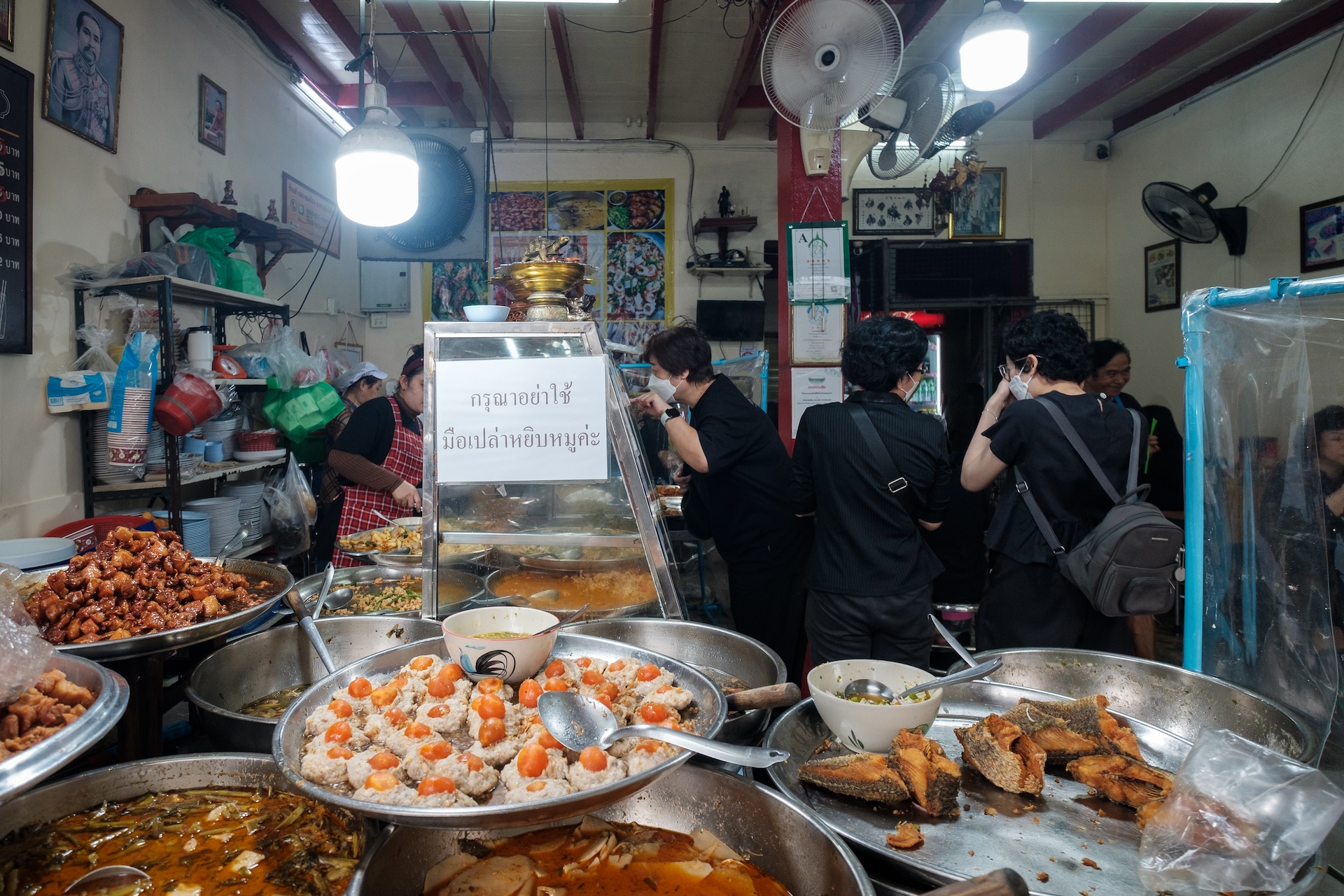


<p>Named for its founder, Mae On, The Original Mae On’s Curry Rice has been a fixture of Bangkok’s Saphan Han neighborhood for more than 50 years. The family-run <em>khao geang</em> shop, near Chinatown and Little India, begins preparing food at 4 a.m., filling silver trays with curries, stir-fries, and regional specialties. Unlike most <em>khao geang</em> shops, where dishes are served over rice on a single plate, Mae On’s encourages sharing, with small plates for mixing and matching. Regular favorites include <em>moo waan</em> (sweet pork), <em>moo khem</em> (salted pork), and <em>khai khem puu jaa</em>, a fried pork-and-crab meatball with a salted egg yolk center. There are also harder-to-find dishes, including northern Thailand’s <em>nam prik ong</em>, a tomato and minced pork chili dip. The generous selection and welcoming atmosphere have made Mae On’s a longstanding favorite for locals seeking a quick, satisfying meal.</p>

<p>At Ban Wannakovit, Apavinee “Taew” Indaransi welcomes diners into the same Bangkok home where three generations of her family grew up. Built by her great-grandfather, who worked in the royal court of King Rama VI, the gingerbread-style mansion now doubles as a restaurant specializing in dishes that have all but disappeared from the city's menus. It's a fitting stop on our <a target="_blank" rel="noopener noreferrer nofollow" class="text-[#781e2a] underline" href="https://culinarybackstreets.com/food-tours/bangkok/backstreet-bangkok-exploring-the-cradle-of-thai-cooking">"Backstreet Bangkok: Exploring the Cradle of Thai Cooking tour,"</a> offering a glimpse into a side of the city's culinary history that's increasingly difficult to find. Taew is particular about the details, whether it's sourcing fragrant bitter oranges for <em>mii krawp</em>, crispy rice noodles in a sweet-and-sour sauce, or preparing <em>khao chae</em>, flower-scented rice served in ice water with an elaborate assortment of accompaniments. Some recipes come from her grandmother, while others have roots in the royal kitchens of old Siam. For Taew, the family home is as much a place to share these dishes as it is to keep them alive.</p>

<p>At Seoul’s Gwangjang Market, a key stop on <a target="_blank" rel="noopener noreferrer nofollow" class="text-[#781e2a] underline" href="https://culinarybackstreets.com/food-tours/seoul/seoul-food-banchan-bibimbap-and-beyond">our food tour in the city</a>, Monyeo Gimbap has been drawing crowds since the 1970s with its deceptively simple rolls filled with just shredded carrot and pickled radish. Founded by Lee Sang-hoon and her daughter Yoo Yang-suk, the stall became famous for its <em>mayak gimbap</em>, nicknamed “narcotic gimbap” because customers couldn't stop eating it. Today, Yoo, now in her seventies, runs the business with her son, Lee Kyung-yeol, keeping the family tradition alive, along with the signature soy-mustard dipping sauce that helped make the rolls famous.</p>

<p>Since 1982, Bonghwa Mukjip has been serving homemade buckwheat <em>muk</em> and regional noodles from a family-run restaurant in Seoul’s Jeongneung neighborhood. Founders Sin Eon-geun and Seo Sun-pil brought recipes from their hometowns in North Gyeongsang Province, including <em>muksabal</em>, a delicate buckwheat jelly served in anchovy broth with kimchi, sesame and <em>gim</em>. Today, their son and daughter-in-law carry on the tradition, grinding and straining buckwheat by hand to prepare fresh <em>muk</em> every morning, a labor-intensive process that yields only about 50 bowls a day. Set inside the family home, the restaurant also serves seasonal <em>geonjin guksu</em>, cold noodles from the Bonghwa region, and pan-fried cabbage leaves.</p>

<p>Akihiro Takayanagi and his wife, Kiwami, run Hakusendo, a second-generation family business tucked behind a colorful candy shop in eastern Osaka's Joto shopping district. What began as an ice cream delivery service evolved into a <em>dagashi</em> candy shop with a hidden, space-age cafe dating to 1970. More than half a century later, the retro interior remains largely unchanged, with a curved counter where regulars gather for siphon-brewed coffee, homemade parfaits, and Akihiro's squid pancakes, prepared using his own secret recipe. Schoolchildren still stop by for inexpensive sweets, while longtime customers return to a place that feels much as it did decades ago. Together, the Takayanagis have preserved a small piece of everyday Osaka that might otherwise have disappeared.</p>

<p>At Hanami Senbei in Tokyo's Kichijoji neighborhood, three generations of the Kida family are keeping the traditional craft of handmade Japanese rice crackers alive. Founded in 1958 by Mr. and Mrs. Kida, the shop is now run by Mrs. Kida, while her daughter Yukiko and grandson Keitaro make the <em>senbei</em>. It's painstaking work: the rice is prepared, shaped, dried, baked, seasoned, and dried again, with each step requiring patience and a practiced hand. In the early days, Mr. Kida carried the crackers up to the roof to dry; today, a dedicated drying room and small elevator make the process a little easier. A stop on our <a target="_blank" rel="noopener noreferrer nofollow" class="text-[#781e2a] underline" href="https://culinarybackstreets.com/food-tours/tokyo/small-town-in-the-big-city-tasting-tokyos-kichijoji">"Small Town in the Big City: Tasting Tokyo's Kichijoji" food tour</a>, Hanami Senbei remains a family business where the skills of one generation are passed directly to the next, even as traditional makers become increasingly rare.</p>

<p>For more than five decades, Lee Ha-yeon has devoted herself to making kimchi, earning recognition as one of South Korea's officially designated Korean Food Grand Masters in 2014. Her specialty is <em>haemul seokbakji</em>, a seafood-rich kimchi once served to royalty during the Joseon dynasty, packed with abalone, conch, octopus, oysters, raw shrimp, cabbage, garlic and gochugaru. Lee learned the foundations of kimchi-making from her mother, who grew her own cabbages, dried chilies in the sun and prepared her own salted seafood. After selling dumplings from a street stall in the 1980s to support her family, Lee opened a restaurant in 1997 and went on to become a leading advocate for preserving Korea's kimchi traditions. Today, she shares her knowledge through teaching, videos, and books, as well as with guests on <a target="_blank" rel="noopener noreferrer nofollow" class="text-[#781e2a] underline" href="https://culinarybackstreets.com/trips/seoul/milk-street-on-the-road-seoul">our culinary trip to South Korea</a>, championing traditional techniques and the importance of good ingredients.</p>

<p>For more than 20 years, Goto-san has been serving handmade gyoza at Osaka-tei, a tiny Chinese restaurant along Osaka's Tenjinbashi shopping street. Five dumplings cost just 250 yen, a price he keeps low for his loyal neighborhood customers. But it's his signature dipping sauce, made with miso, sesame, and vinegar instead of the usual soy sauce and vinegar, that makes his gyoza particularly memorable. Goto is also a devoted supporter of local children's baseball and scouting groups, and his generosity extends to the restaurant, where <a target="_blank" rel="noopener noreferrer nofollow" class="text-[#781e2a] underline" href="https://culinarybackstreets.com/food-tours/osaka/handmade-osaka-craft-flavor-the-shokunin-spirit">he welcomes Culinary Backstreets guests on our food tour even before opening hours</a> and often sends customers off with a little chocolate treat. For his regulars, he's as much a part of the neighborhood as the restaurant itself.</p>

<p>At Didean, a small Sri Lankan curry and fermented food restaurant in Tokyo’s Monzen-Nakacho neighborhood, husband-and-wife duo Shinichi (“Shin-chan”) and Mizue-san have spent more than 25 years exploring the possibilities of fermentation. A former sports journalist, Shin-chan developed his fascination with fermented foods after Mizue-san’s health struggles led the couple to study traditional Chinese medicine and, later, Ayurveda in Sri Lanka. Today, their restaurant doubles as a laboratory for experimentation, where homemade miso, amazake, <em>shio koji</em>, and pickles share space with Sri Lankan-inspired cooking. Shin-chan’s infectious enthusiasm is a highlight of our "<a target="_blank" rel="noopener noreferrer nofollow" class="text-[#781e2a] underline" href="https://culinarybackstreets.com/food-tours/tokyo/the-spirit-of-tokyo-exploring-old-school-monzennakacho">The Spirit of Tokyo: Exploring Old-School Monzen-Nakacho"</a> tour, where he introduces guests to Japanese fermentation through tastings, demonstrations, and plenty of jokes. His nearly 30-year-old <em>nuka</em> pickling bed occasionally yields a forgotten vegetable, which he happily turns into another lesson. For Shin-chan and Mizue-san, preserving tradition means never stopping experimenting.</p>