S M B O measurement-vertical measurement-vertical

Latest Stories, Marseille

Keeping the Faith

Outside brightly lit halal butchers, djellaba-clad women line up for lamb to make chorba stew. Tables heave with honey-soaked pâtisseries orientales, covered in plastic to protect them from flies. From fragrant bundles of mint to the mouthwatering smoke of rotisserie chicken, the tantalizing scents on the Rue Longue des Capucins are a sure-fire way to make you hungry. For those fasting for Ramadan, it is the ultimate test of self-control. The teeming stalls of foodstuffs give Noailles its nickname as the belly of Marseille. During Ramadan, the Marseille neighborhood fattens up. It is a mecca for ingredients and prepared food for iftar – the sundown meal that breaks the fast. “Noailles is as close to Morocco as I can get,” says Rachid Zerrouki, a teacher and journalist based in Marseille for years.

Raising the Bar

Since the coronavirus crisis began in France, our computer and TV screens have been with barraged with public health missives. The Alerte France ads feature a four-pronged plan to “protect yourself and others.” The first step, “wash your hands very often,” has made good old-fashioned soap the best anti-viral weapon – especially due to the drought of antibacterial gel. Consequently, the emblematic savon de Marseille – an olive-oil based soap that makes use of Provence’s green gold – is more popular than ever, turning the city’s savonneries into unintentional ambassadors of public health. One of them, Savonnerie Fer à Cheval, has been particularly prepared for the role.

Kitchen Brigade

To make my 12-person quiche I need: 12 eggs, 4 cups of cream, a pound of Emmenthal and two giant bags of frozen spinach. No, I’m not on lockdown with a soccer team, nor am I hosting an illicit dinner party. I am cooking for the nighttime ER team at the Hôpital Nord. My effort isn’t a solo act, but in alliance with one of the grassroots associations created in response to the coronavirus crisis. The clearly named Cuisinons Pour Les Soignants de l’Hopital Nord (Cook for the Medical Staff of the Hopital Nord) gathers local home cooks, restaurants and food purveyors to make meals for hospital staff. For those who aren’t culinarily inclined but want to contribute, Pizza du Coeur delivers Marseille’s most popular food to caregivers.

Vive Le Pâques

Though half of France’s population is officially Catholic, only 5 percent of the country regularly attends mass. Yet, les français still remain faithful to their Christian holidays. After Christmas, Easter is the second-most popular fête – perhaps because it falls on a Sunday, when lunch en famille is a French tradition that is as revered as a religion. Like many nations, chocolate is France’s essential Easter ingredient. Not surprisingly, the French exception – the country’s belief that they are unique – extends to the shape of their holiday confections. Here, a cloche (bell), not a rabbit, delivers Easter’s chocolate-y treats. How did an inanimate object become the bearer of sweets?

Coronavirus Diary

This past Friday I wrote the following reflection on how Marseille is coping with the coronavirus crisis: “Marseille’s most visited monument, Notre Dame de la Garde, hasn’t seen a decline in visitors to her golden beacon. At La Samaritaine, the iconic Vieux Port café, locals pack the terrace to soak up the sun. And, when taking public transit, I rarely spot a face mask. Unlike the empty piazzas in Milan and the masked subway riders in NYC, it’s been smooth sailing in this port city.” That was clearly the calm before the Covid-19 storm.

Vertes claires, oysters that are finished in algae ponds, at Maison Calambo in Marseille, photo by Alexis Steinman

If Marseille is a city of 111 villages, Cinq-Avenues is a village that feels like a mini-metropolis. From boulangeries to boucheries, the neighborhood brims with personable local businesses rather than impersonal chain stores. Some places have seen generations pass through their doors – like Maison Calambo, a family-run spot that has been shucking shellfish since 1946. Named for a species of gray shrimp found in the Atlantic and the Mediterranean, this small écailler (the French word that is both noun – oyster seller – and verb – to open an oyster) embodies the prized Gallic custom of seafood stands. On Christmas, New Year’s Eve and during other celebrations, French families gather around teeming shellfish platters, the perfect pairing to festive bubbles and the ideal antidote to fatty foie gras.

Café de la Banque

Some of Marseille’s most majestic buildings surround the Estrangin métro stop: the American consulate, the ornately sculpted Caisse d’Epargne bank, and the Napoleon-style Préfecture. Between them sits an equally iconic institution, Café de la Banque. Yet while its high-profile neighbors deal in banking and bureaucracy, this spot serves something more essential: a dependable place for delicious food and drink. Named for the surrounding banks, this non-stop café is a neighborhood fixture that hums all day. Regulars fill the old-timey interior and one of Marseille’s best patios for a morning café, the perpetually packed lunch service, and post-work beverages. In a city whose Mediterranean identity often sets it apart from the rest of France, Café de la Banque serves up a comforting slice of classic French café culture.

Ahwash

Once the stomping ground of sailors and the Corsican mafia, Marseille’s oldest district, Le Panier, has evolved into a tourist hub and creative neighborhood. Its winding streets are peppered with ateliers (like blade smiths, chocolatiers and painters) and the 17th-century facades are canvases for colorful murals. One of them, a powerful black-and-white image of a couple kissing, faces the funky cantine and concept store, Ahwash. Its owner, Amar, commissioned the Alberto Ruce work – a sign of the artistic energy infused throughout his unique place. Named for the traditional Berber dance in which men and women mix together, Ahwash is a blend of Amar’s worlds – of Morocco and France, of art and cooking. “Eating here is like coming to my house,” he smiles, serving tagines to patrons sitting at vintage tables topped with glowing candles, their dripping wax embodying the restaurant’s romantic and relaxed ambiance.

Monsieur Madame

Chefs have long touted – and scientific research has confirmed – that we “eat with our eyes.” Hence the swishes and swirls of plating. Yet the importance of visual stimulation extends beyond food to include restaurant design, a point that is not lost on the all-day café Monsieur Madame. The eye-catching space is so full of ‘60s and ‘70s knick-knacks that you might mistake it for a vintage shop. Vinyl records are used as placemats on the brightly colored Formica tables. Shelves overflow with old cameras and plastic figurines. From wooden crosses to mounted fish heads, the walls offer a visual feast – so chock-a-block with mementos the vivid print wallpaper is somehow mellowed.

Best Bites 2019

Editor’s note: We’re celebrating another year of excellent backstreets eating by reflecting on our favorite meals of 2019. Starting things off is a dispatch from Alexis Steinman, our Marseille bureau chief. This year began with a bang, when Marseille nabbed a coveted spot on the New York Times’ “52 Places To Go in 2019” list. Written by food writer Alexander Lobrano, the blurb lauded the city’s ever-expanding food scene. Throughout 2019, new restaurants opened, captained by chefs who trained at local tables, first-timers emboldened by the city’s entrepreneurial energy and Parisians seeking sun and the easygoing vibes that go along with it.

Café Luciani

When ordering a café in Marseille, keep your eye out for sugar packets and espresso cups lined in yellow and white. These diagonal stripes are the sign of Café Luciani, a logo inspired by the red and white panels on truck tailgates. Yet while those stripes implore you to be careful and hang back, Luciani encourages the opposite – they want you to dive head first into your cup of coffee The father-and-son coffee company began in 1863 as the Phocéenne de Torréfaction (the Phocaean Coffee Roaster), named after the lineage of the sailor who founded Marseille. Pascal Escudier’s locally roasted coffee was reputed for its “exquisite aromas” in an era when the petit noir was more about consumption than the quality of its composition.

Cristal Limiñana

Anise-based liqueurs are as ubiquitous as outdoor terraces across the Mediterranean. Long prized for its medicinal benefits, anise is the ideal antidote to the region’s sweltering temps, especially when sipped in tall glasses with refreshingly chilled water, as is common practice. From Turkey’s rakı to Italy’s heavily sweetened sambuca, each country has its own recipe. France has two, anisette and pastis, with the latter having licorice root thrown into the mix. Born in Marseille, pastis is the republic’s most popular aperitif, but both beverages are poured at bars around town, whose shelves are stocked with bottles from a variety of producers. There’s one brand, though, that deserves special attention: Cristal Limiñana, one of the city’s last distilleries.

Imported image from WordPress content

Anthony the Great is the patron saint of pigs, hence why paintings of him often depict one at his feet. Some say that a pig accompanied him during his hermetic desert life in the 3rd century. Some say he used pork fat to heal skin disease – one of the acts that is linked to his sainthood. Regardless of its reason, all swine-related matters fall under Antoine le Grand’s guardianship. Which is why many charcutiers (pork butchers) in France bear his name. Case in point: Marseille’s Au Grand Saint-Antoine, a name that confuses some locals since it’s the same as the ship that brought the devastating 1720 plague into the city. The charcutier-traiteur actually began as the Fromagerie de l’Est in 1922, a cheese shop that dabbled in charcuterie and chickens.

Maison Journo is known for its Maghrebin pastries, Marseille, photo by Alexis Steinman

At a typical pâtisserie orientale, the front window is often stacked with towers of sweets – honey-soaked visual merchandising to entice passersby to pop inside. Some pastry shops line their walls with colorful geometric tiles and Moorish arches, the icing on the Maghreb cake. Pâtisserie Orientale Journo goes for a decidedly more subtle approach. Though located a block from Marseille’s main drag, the Canèbiere, this unassuming shop is somewhat lost in the shuffle of the pedestrian Rue de Pavillon. The few tables scattered out front suggest that there’s food to be found inside but the open storefront is bare – save for a giant five-gallon water jug propped on a stool, with a hand-scrawled sign “citronnade – 2 euros” beside it. That’s all the advertising needed for a pastry shop that has survived by word of mouth for 60 years.

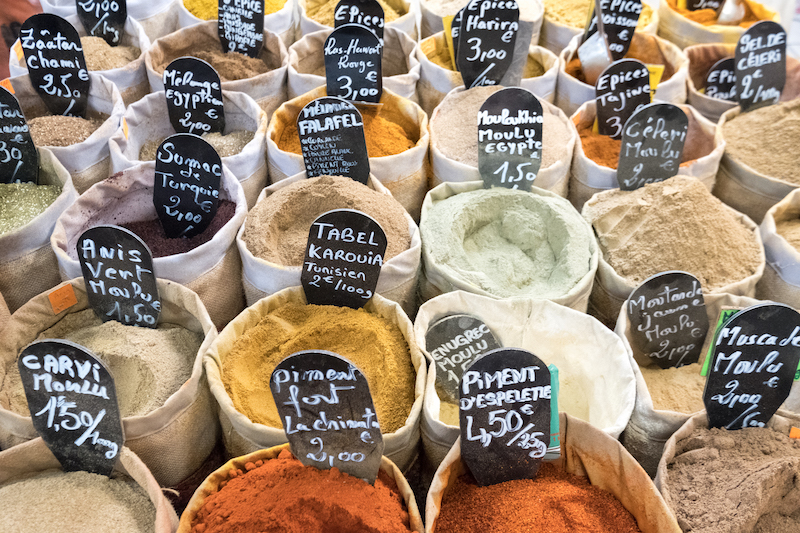
Spices from all over the Mediterranean on sale in Marseille, photo by Medi Musso

Editor’s note: We are very happy to be able to add Marseille to the growing list of cities CB is covering. Our coverage of that city’s deep and fascinating culinary scene begins today, with our report on Marseille’s State of the Stomach. On the Rue d’Aubagne, Tunisian men dunk bread into bowls of leblebi – a garlicky chickpea soup – as scooters dash by. A dashiki-clad Senegalese woman plucks cassava from the produce market to fry up for lunch. Dusted in flour, Lebanese brothers make falafel sandwiches with pita still warm from their bakery’s oven. A boy buys an Algerian bradj – a date-stuffed semolina bar – to snack on after school as Maghrebi teens in track pants sell single “Marl-bo-ros.” This multicultural montage unfolds along the main artery of the Noailles neighborhood, known as the “belly of Marseille” for its abundant edible offerings and central location.

logo

Terms of Service