Latest Stories

Catalan Cheese, Part 3: The New Wave

Cheese has a very long, storied past in Catalonia, as we wrote in the previous parts of this series. But what do the present and future of Catalan cheesemaking look like? The 21st century has seen cheesemaking flourish dramatically in Catalonia, thanks to increasing interest in and appreciation of culinary traditions and trends worldwide, not to mention the financial crisis of 2008, which led many people to make career changes or to take up a more DIY ethos. All of this, combined with that old Catalan inclination toward modern design and creativity, has made for a heady mix. The new generation of cheesemakers comes from a wide range of professional backgrounds; many are college-educated and well-traveled, and accordingly, they have specific aesthetic, gastronomic and nutritional criteria.

First Stop: Caroline Eden’s Istanbul

Editor’s note: In the latest installment of our recurring First Stop feature, we asked travel writer Caroline Eden about some of her go-to spots in Istanbul. Eden has written for the Guardian, the Telegraph and the Financial Times, among other publications, and has filed stories from Uzbekistan, Ukraine, Russia, Kyrgyzstan, Kazakhstan and Azerbaijan for BBC Radio 4’s From Our Own Correspondent. Eden is also the author of the culinary travelogue Black Sea: Dispatches and Recipes, Through Darkness and Light (Hardie Grant; May 2019) and co-author of Samarkand: Recipes & Stories from Central Asia & the Caucasus (Kyle Books; July 2016), a Guardian book of the year in 2016 and winner of the Guild of Food Writers Award for best food and travel book in 2017. You can follow Caroline on Instagram and Twitter @edentravels.

Recipe: Bife à Portuguesa, Portugal’s Saucy Signature Steak

In most countries around the world, it’s safe to say that steak is a minimalist affair – a dish that, in some cases, combines perhaps no more than beef and salt. In Portugal, however, people tend to go in the other direction. “It’s a steak that’s pan-fried, and served with smoked ham, bay leaf, garlic and white wine,” says Manuel Fernandes, when we ask him to describe the country’s signature steak dish, bife à portuguesa, “Portuguese-style steak.”

Mount Everest Deli: The Momo Bodega

Mount Everest Deli may appear, to many of its customers, interchangeable with its neighbors – Globe Smoke & Convenience, Seneca Deli Corp., or any of the dozens of Ridgewood bodegas that are instantly familiar to any New Yorker. Passersby on Myrtle Avenue dash in for a pack of cigarettes, a tube of off-brand super glue, or a turkey bacon-egg-and-cheese on a roll. But inhale deeply while shopping there and you’ll smell masala. Peek behind the deli counter and you’ll see momos – Himalayan dumplings – tumbling onto the griddle. Mount Everest isn’t just a corner store. It’s a distinctive, tradition-bending urban Nepalese restaurant.

Arancini from Basile Focacceria del Massimo, Palermo, photo by Francesco Cipriano

Sicily’s rich, volcanic soil has borne many fruits: grapes, figs, peaches and citrus, to name just a few. It has also cultivated fiery debates and regional rivalries about details of traditional recipes; culinary wars whose significance is usually lost on most non-Italians. One such debate concerns the proper way of pronouncing one of Sicily’s most beloved snacks: the arancini (plural) – stuffed rice balls, battered and deep-fried. Whereas the west of the island refers to it as arancina, the east calls it arancino. Cue Spaghetti Western music. Over the centuries, Palermo has experienced and absorbed various cultures and their cuisines. The influence of Arabs and North Africans play an especially prominent role, dating back to the period of 827-1091 A.D.

Iftar Al Fresco

As the call to prayer drifts from mosque to mosque and lights flicker on in anticipation of dusk, everyone around us takes a sip of water and wolfs down a date, almost in unison. It is the start of Ramadan and, here in Sultanahmet Square, folks are breaking their first fast of this holy month. They have been waiting patiently for the loud cannon blast which announces the day’s end – a tradition of old that still persists here in the square, though the loud bang often frightens unsuspecting tourists – sitting on blankets spread in the square’s grassy patches and pulling tupperwared iftar meals out of plastic bags and picnic baskets.

Beirut Saj: Lebanon Comes to Tbilisi

Aghmashenebeli avenue – the main street on the left bank of the Mtkvari River – is well-known for its Turkish eateries and the presence of Barbarestan, a popular Georgian restaurant. But a handful of new food joints have opened recently, serving mainly Indian and Middle Eastern food, and sometimes a mix of both. One of these new spots is Beirut Saj, which opened in April 2022. The venue is easy to miss when walking along the never-ending Aghmashenebeli avenue – its entrance is discrete and you have to take a few steps down to enter. A hint that you’ve arrived at the right place is the sight of barber shops. A Turkish barber is located upstairs, and next door, in the basement, is a Lebanese barbershop called Miami.

The grill outside Cantinho do Aziz, photo by Rodrigo Cabrita

Lisbon’s communities from Portugal’s former colonies provide the strongest link to the country’s past, when it was the hub of a trading empire that connected Macau in the east to Rio de Janeiro in the west. Though integral elements of Lisbon life, these communities can sometimes be an invisible presence in their adopted land, pushed out to the periphery of the city. With our “Postcolonial Lisbon” series, CB hopes to bring these communities back into the center, looking at their cuisine, history and cultural life. In this third installment of the series, we dive into Lisbon’s Mozambican community. 

Market Watch: Junk and Food at Lisbon’s Feira do Relógio

We didn’t exactly receive a warm welcome at Feira do Relógio, a weekly market that unfolds along a suburban strip north of Lisbon’s city center. “I saw you taking photos from the bridge! What are you doing?” shouted a man as he approached us aggressively. “You can’t take photos of people!” We explained calmly that we were taking photos for an article, and that people would not feature in those images. He hassled us a bit more before eventually wandering away. Later, we saw him selling knockoff socks from a bag slung over his shoulder. The rest of our visit was event-free, but the incident was a reminder of the occasional semi-legal nature of this market.

Pizza Marumo: The Dough Whisperer

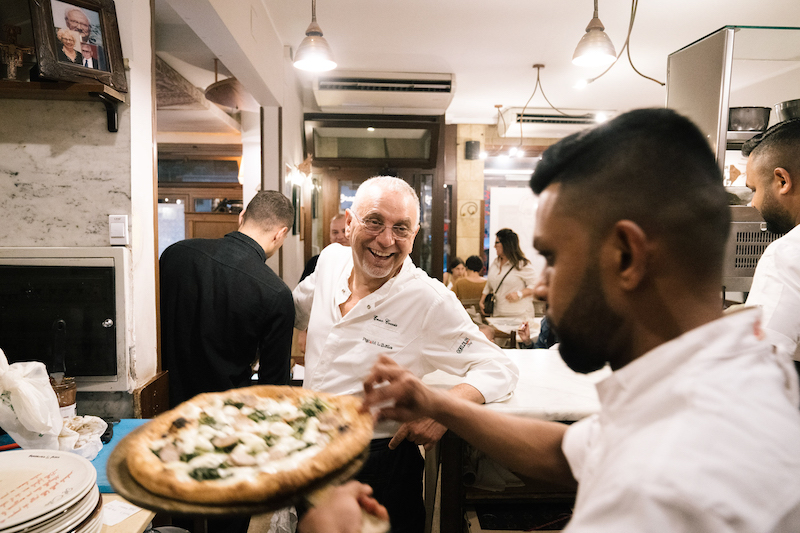
Every day, Yuki Motokura records the temperature and the humidity, and checks in on his pizza dough. He adjusts the flour, water and salt in minute increments, and logs the results with precision. “Even if the data is the same, it might not come out the same,” Motokura says. “Pizza is just that difficult.” While there’s no failsafe trick, he says he’s developed a kind of sense for how the dough might behave during his years of experience. “I lift the lid on the fermenting dough and I have a kind of discussion with it,” he explains. “‘What shall we do today?’”

Oaxacan Craft Beer: A Tale of Three Taprooms

The sunny, dry Oaxacan climate creates the perfect setting for enjoying cold drinks. While Oaxaca is known worldwide for its mezcal production, it’s beer that’s easily the most popular drink across the state. Whether served in ice-cold glasses with a plate of salty peanuts, alongside juicy tacos or guacamole, beer – affordable and easier to handle than other spirits – is very likely to be the local drink of choice. One of the oldest alcoholic drinks in history, beer entails a universe of styles, flavors and textures continually explored by brewers all around the world, and Oaxaca doesn’t want to be left behind.

Nestou: Return to Marseille

Like other young French chefs who receive classical training in their home country, Jeanne and Jean-Phillip Garbin headed abroad to gain some practical experience. The couple, in fact, went all the way to Australia, only to find themselves working brutally long hours and longing for home. The two eventually returned to France, landing in Marseille – Jeanne’s hometown – where for the last two years they have been running Nestou, a cozy spot in the Catalan neighborhood that allows them to cook a small selection of fine French-Mediterranean food and maintain a positive, comfortable atmosphere.

Rakoumel: An Island of Cretan Culture in Athens

There’s something about Rakoumel that tastes like home. You might not have a Greek grandma, but dig your fork into any of the dishes here, and for a moment, you can almost imagine you do. The space itself is cozy, with indoor seats that look into a garden and the kitchen to the back. In the front, the sidewalk is speckled with tables that are almost always full, and live music spills into the street when bands set up at one of the tables. It’s a place where raki flows, where an electric energy invites you to come back and feel like you’re part of the family. And Rakoumel is, in fact, a family business. The owner, Yiannis, opened the restaurant 17 years ago with his mother, Argyro.

Pastéis de Belém: Birthplace of the Pastel de Nata

It was something almost unheard of: there was no line. We could have walked right into Pastéis de Belém, ostensibly the most famous pastry shop in Portugal – if not in the world – an exceedingly rare occurrence since Portugal’s tourism boom. But we had already wrangled a way in; we had an appointment with Miguel Clarinha, the fourth-generation owner of the iconic Lisbon bakery, who had agreed to give us a behind-the-scenes tour. Pastéis de Belém claims to be the inventor of the egg tart, known generally in Portugal as pastel de nata, “cream pastry,” but here as pastel de Belém. The story goes that the sweets – pastry cups filled with an egg and cream custard – have their origins in the Jerónimos Monastery, steps away from the bakery’s current location in Belém, just west of Lisbon.

Caffè del Kassaro: Market to Table

The myriad walks around the streets of Palermo can stir up a variety of feelings – curiosity, awe, wonder. Strolling around the centro storico, the historic city center, one can’t help but feel that the city is drenched in history. The area is dotted with miracles; Phoenician and Roman vestiges, buildings dating from the Gothic, Renaissance, Baroque and Arab-Norman-Byzantine eras. Palermo’s oldest street, Corso Vittorio Emanuele II, was once called Via del Cassaro. The name Cassaro, which means castle, derives from the Arabic noun Al-qasr, becoming U Cassaru in the Palermitan dialect. The castle was the original city center and this street, connecting it to the seashore, was one of Palermo’s main arteries.

logo

Terms of Service