Latest Stories

Earthquake Aid From Istanbul: Feeding and Supporting Those In Need

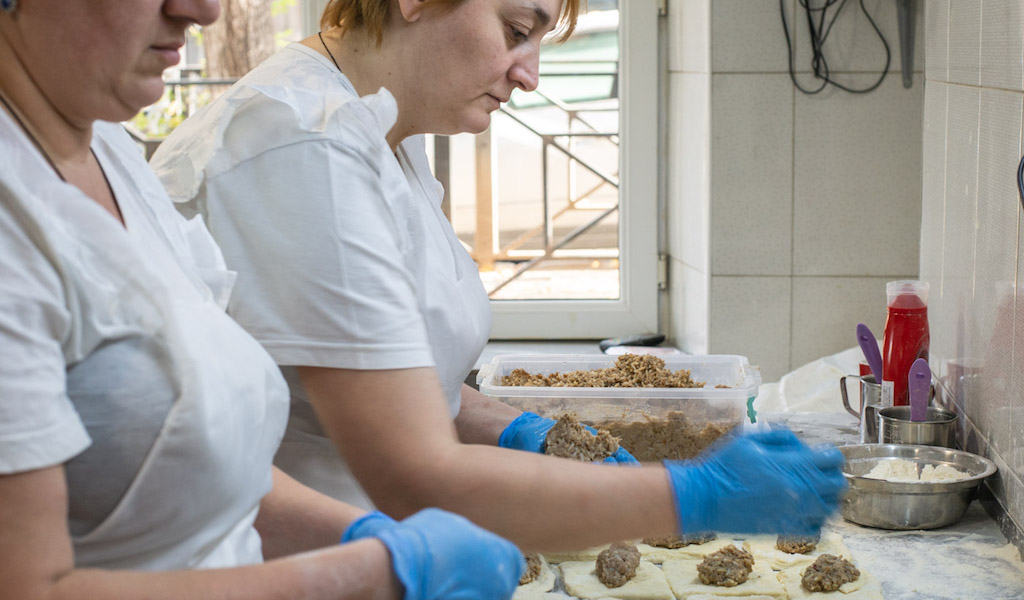
Chefs Kaan Sakarya and Derin Arıbaş usually spend their days preparing elegantly plated dishes like lamb tenderloin with warm cherry freekeh and purslane at Basta! Neo Bistro, the duo’s second joint venue in Istanbul’s Kadıköy neighborhood after their popular gourmet-wraps spot Basta! Street Food Bar. Both trained at French culinary institutes, they still refer to mise en place when talking about their prep cooking – even when that means setting things up inside a tent to make vats of soup to serve 700 people. Since a pair of massive earthquakes struck a broad swath of southeastern Turkey on February 6, more than 200 chefs from across the country have headed to the disaster area as part of an ad hoc response called the Acil Gıda Kolektifi (Emergency Food Collective).

O Buraco: In the Trenches Featured Image

Manuel Azevedo and Francisco Moreira, now both in their 70s, have been friends since childhood. Such a close connection has afforded them the trust and togetherness required to run O Buraco, the restaurant in Porto that the duo have presided over like generals for almost 50 years. In fact, it was right after completing his military service that Manuel, a native of Marco de Canaveses, a city within the greater Porto municipality, came to Porto proper in search of work. “I picked up the newspaper, saw the ad, applied and was hired as a waiter,” he tells us. On February 4, 1971, he entered O Buraco (“The Hole” for the first time; he hasn’t left since.

Taberna Sal Grosso: The Revivalists

“I’m afraid there are no tables for the next week or so.” This has become the most-repeated phrase lately at Taberna Sal Grosso, a small space which first made a significant impact in Lisbon restaurant scene nearly eight years ago. Now, after a couple of challenging years due to the pandemic, the 25-seat-spot is again one of the most coveted in town, attracting both locals and in-the-know visitors. If Sal Grosso (“Coarse Salt”) helped to breathe new life into the old Lisbon tradition of enjoying beer, wine and petiscos in a small tavern, its second life – now with new owners and chefs – brings another breath of fresh air to this corner of Santa Apolónia, on the margins of the Alfama neighborhood.

Denassus: Follow Your Nose

Denassus can be found in a narrow space on Blai Street in Barcelona’s Poble Sec neighborhood. Here, the bar occupies nearly half the room, with little tables lining the other side. Upon entry, we are greeted by the jubilant god of wine himself: the giant face of Bacchus, covered in grapes, looks down on us from the wall above. He presides over the scene: a warm, relaxed atmosphere in which to enjoy natural wines and thoughtful dishes. It’s not easy to find a place that blends quality and fair prices, tradition and modernity, identity and open vision, all into one easy-going style. Denassus has this touch.

Bina 37: Wine Cellar in the Sky Featured Image

We are on the eighth floor terrace of a relatively new apartment building in the Vedzisi neighborhood, nodding our heads with joker grins like gawkers at a freak show. The view is as spectacular as they come in mountainy Tbilisi, but that’s not what we’re chuckling at. There are 43 ceramic urns – kvevri – buried almost a meter and a half into a bed of sand and perlite in what was supposed to be a swimming pool for a nine-year-old boy. But in an epiphanic moment, the child’s father, 43-year-old doctor, Zura Natroshvili, decided to build a marani in the sky instead. The father of modern advertising, David Ogilvy, once said, “The best ideas come as jokes.” Dr. Natroshvili would probably agree. His friends thought he needed psychiatric help when he first shared his idea.

Introducing Palermo: Through the Eyes of Our Local Team

To properly introduce Palermo, CB’s newest location, we turned to our local experts: correspondent and photographer Francesco Cipriano and walk leader Maria Luisa. In celebration of the launch, we spoke with them about Palermo’s gastronomic scene, the special Sicilian relationship with food, and their favorite places in the city. Francesco is a writer and photographer born in New York to a family of Sicilian immigrants who then moved to Switzerland before finally returning to Sicily – the place, he says, that feels the most like home. Maria Luisa is a native Sicilian and a professional culinary guide. She got her culinary start from her grandmother, who taught her how to knead dough to make bread, how to forage for wild plants and how to appreciate a good glass of wine.

CB on the Road: The Culinary Magic of the Tabernas do Alto Tâmega Featured Image

We weren’t entirely sure if we were in the right place. Upon reaching the summit of a comically steep driveway, Casa de Souto Velho appeared more private home than restaurant. And even if this was indeed our destination, we had not made a reservation. Nonetheless, and despite having a virtually full house, Eufrásia Almeida welcomed us inside, and within seconds our table was loaded with a bottle of wine made from local grapes, a plate of house-made preserved meats, and a basket of house-baked bread. After lunch – more on that later – her son Pedro showed us around the garden, the chicken coop, the pig pen and the smokehouse, and even drove us to see the family vineyard. Regardless of where we had arrived, we were, we felt, at home.

After the Earthquake: Pain and Solidarity in Turkey's Culinary Capital

The southeastern Turkish city of Gaziantep is famed for its rich gastronomic culture, vast array of historic sites, and bustling bazaars. It was among the cities hit by the disastrous 7.8 earthquake on February 6 that has claimed more than 40,000 lives in Turkey and northern Syria. While Gaziantep fared much better compared to some of its neighbors in the region including Antakya, Kahramanmaraş and Adıyaman, the city was still struck in no small way. Large sections of its 2000-year-old fortress collapsed, and numerous centuries-old mosques in the historic center were damaged to varying degrees. High-rise apartments in the upmarket part of town were riddled with cracks and rendered uninhabitable.

Second-line Sunday Vendors: What You Need, When You Need It

New Orleans’s Social Aid and Pleasure Club tradition brings funky brass music and hard-grooving street dance out of the nightclubs and straight into the streets. On roughly forty Sundays a year, these neighborhood-based social clubs throw roving street parties that course through the city backstreets and boulevards – a hard-dancing flash mob powered by funky sousaphones and flanked by parade-savvy New Orleans police escorts. These “clubs” began in the late 19th century with a double-barrel mission. In their “social aid” role, they raised money year-round for helping community members through difficult and often unforeseen tragedies (sickness, untimely passings) in the years before modern insurance plans. In the “pleasure” category, the clubs developed and refined a parading and street dance tradition that rules the city streets on most Sunday afternoons.

Ayara Thai: Noodles, With a Kick

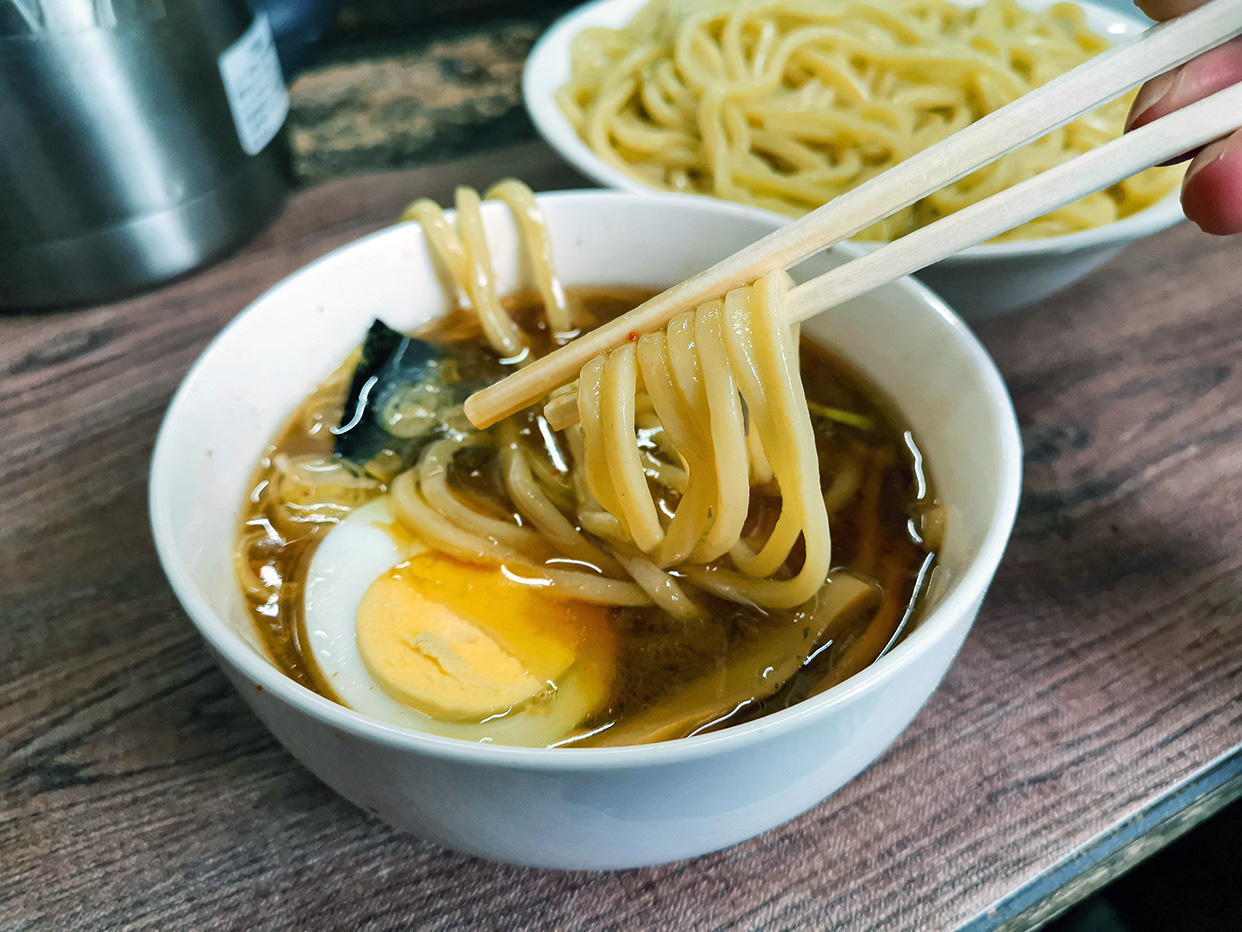
Every few months, a small part of quiet West 87th Street near the Los Angeles International Airport turns into a scene of nighttime street food. On these evenings, Ayara Thai – a family-owned restaurant that has been around for 19 years – sets up a makeshift kitchen on the street and puts tables out on their sidewalk and the street patio that was originally installed during the pandemic shutdown. Thai hotpot, barbecue and street food popups are among the special events Ayara Thai holds throughout the year, but there is one that is the most unique and perhaps the most popular: the kancha boat noodle. Thai boat noodle is a noodle soup with a rich broth made from pork or beef, dark soy sauce, herbs, and typically thickened with cow or pig’s blood.

Soul Food House: Southern Comfort in Tokyo

LaTonya Whitaker’s favorite food is catfish, but the dish she loves cooking most at Soul Food House is the gravy chicken and waffle. Craving country-fried chicken and waffles one day but not having the space for both, she simply – in her words – “mashed it up and put the gravy on.” It’s not our first rodeo at this restaurant in Azabu-Juban. This time, on LaTonya’s recommendation, we tackled a plate of waffles larger than our faces, palm-sized pieces of country-fried chicken on a bed of mashed potatoes, the whole affair drenched in gravy and a small pitcher of maple syrup alongside. It’s unabashedly over-the-top. You have to eat fast, or risk the whole thing turning into stodge.

John’s Pizzeria: A Slice of Nostalgia

The eye-catching vintage sign proclaims: “ohn’s Pizzeria.” The letters in “Pizzeria” are in the bold carnivalesque font that decorates many decades-old slice joints in New York. As for “ohn’s,” it’s missing a one-of-a-kind flourishing cursive capital letter. “The J fell off,” says Susan Bagali, while ladling sauce onto a Sicilian pie behind the counter. “I called three companies and none of them could fix it right. I don’t wanna change it at all.” John’s Pizzeria’s unchanged appearance is exactly what first caught our eye while the corner restaurant was shuttered during the entire Covid-19 pandemic – for good, we worried.

Queijaria da Praça: The Green Cheesemonger

Queijaria da Praça sits in the Praça do Marquês neighborhood, in a cozy space where the temperature does not exceed 15ºC and the pungent aromas of cheese penetrate the nose as soon as one steps in. “When we opened, we wanted the store to be here,” owner Diana Guedes says. Far from the tourist areas of Baixa or Ribeira, crowded with visitors and more mass-market shops, the Praça do Marquês neighborhood is one of the best examples in Porto of bringing together a balanced mix of shops and residential buildings. “As we have many buses and a metro line, it is a crossing point for many people, which is very interesting for us, of course,” she explains. The location also helps to attract a more niche public of connoisseurs.

Chocolate Macondo

Initially, it was books that led Fernando Rodriguez Delgado to his interest in cacao. Today Rodriguez runs Chocolate Macondo, a café that specializes in ancient preparations of cacao, but prior to that he was a bookseller, fanatical about reading and fascinated by the history of Mexico. The day that he came across the Florentine Codex, a 16th-century manuscript documenting Mesoamerican culture, was an important one: it would eventually spark his countrywide search to discover the traditions of cacao and seek out ingredients, the names of which he only knew in Nahuatl. Rodriguez didn’t speak this native language of Mexico, so trying to work out the recipes for cacao drinks he found in the codex was no easy task.

Gunda: Khachapuri Revivalists

Google khachapuri and the top images that pop up are that of the classic boat-shaped version, its golden orb of an egg yolk cracked in the center of melty cheese still bubbling fresh out of the oven. This classic recipe from the Black Sea coastal region of Adjara that gives it its name, Adjaruli khachapuri, is undeniably one of the most iconic visual representations of Georgian cuisine. While indeed an undeniably photogenic and enticingly seductive dish, the Adjaruli khachapuri’s domineering image often obscures the fact that there are dozens of different varieties of the khachapuri that exist around the country. Most restaurant menus options are also often reduced to just a handful of varieties, like the imeruli, with a single layer of cheese baked inside, the more opulent megruli, which adds a crust of cheese on top, and the all too ubiquitous Adjaruli.

logo

Terms of Service