Latest Stories

Beans & Beats

In Rio, there’s a saying, “And once again, suddenly it’s Carnival.” It’s a joke, of course – as if Carnival didn’t occupy cariocas’ minds a significant part of the year. But the truth is that, in a way, this is precisely what’s going on right now in the “Wonderful City.” Official Carnival events begin in two weeks, but the samba shows, parties, feasts and merriment are everywhere. Suddenly, it’s already Carnival. And this early Carnival mood expresses itself better every year at the samba schools’ rehearsals for the official parades, which are scheduled to begin on February 24. From next Thursday until then, at least 15 parties will take place at the most important samba schools’ headquarters, as well as in the Sambadrome – Rio’s main parade zone – itself.

Lipa

Convincing someone to accompany you to Istanbul’s Pendik district is no small feat. The Asian-side suburb is located in the far eastern reaches of the city, a trip of at least an hour and a half from the city center requiring no less than three metros and a cab. We've been met with moans and groans upon mentioning the name, as the district is synonymous to many with the wildfire-like urban sprawl that has engulfed Istanbul over the years. Those up for the journey, however, are rewarded handsomely at Lipa, a meyhane serving Bosnian specialties. The neighborhood of Sapan Bağları is home to a large population of natives from Sandzak, a predominantly Bosnian Muslim region now split across modern-day Serbia and Montenegro.

CB on the Road

In the southwestern part of Catalonia, in the province of Lleida, lies Les Garrigues, where the gray-green foliage of compact Arbequina olive trees stretches across some 20,000 hectares of the soft, dry landscape. This is where one of Spain’s best extra-virgin olive oils is produced. The olive tree has been cultivated in Catalonia since at least ancient Roman times, although it was probably first introduced by the Greeks in 600 BCE. Its cultivation developed alongside other typical crops that flourish in a dry climate – such as almonds, grains and grapes – until growing olives and producing olive oil became the main industry of Les Garrigues in the 19th century.

Lakerda

The fatty torik – the Turkish name for a large, mature Atlantic bonito, similar to the little tunny – courses the straits of the Bosphorus and the Dardanelles for just a short period each year in November and December. Yet the people of Istanbul eat it year-round by preserving the fish in a light brine, something it seems they have been doing for millennia – the Byzantines even minted coins with an image of the fish. Making lakerda is more than a means to preserve bonito for the rest of the year, however; it’s part of the city’s culinary instinct. Around 5 a.m. one recent morning in Yenikapı, yellow rubber boots were piled high in front of the one serene spot on the sprawling grounds of the Municipal Fish Auction.

Philippou

Kolonaki, or “little column” in Greek, might just be Athens’ most iconic neighborhood, forever synonymous as it is in the minds of Athenians with the wealth and idiosyncrasies of its affluent residents. Occupying the area from Syntagma square up to Lycabettus hill, it’s full of swanky boutiques, cafes and restaurants. However, one of its most famous hidden gems is actually the unfussy Philippou, a small family-run eatery that sits on a tree-dotted street away from the hustle and bustle of the main square. Founded in 1923 by Kostas Philippou, it began as a humble taverna with earthen floors and big barrels filled with home-made wine.

Drink Local

Portugal may be known for its abundance of wines, but beer also has a centuries-old history here, with production rooted in local traditions. It’s a story that has quietly been forgotten, but it seems like now is the right moment for a revival. Portugal’s beer landscape has since the 1940s been dominated by the Sagres-Super Bock duopoly, whose common lagers are nothing to write home about. Created out of a merger between previously competing associations, these two new brands (grouped under Central de Cervejas e Unicer) had a huge impact on Portuguese beer habits. The new industrial focus on a simple and standard product effectively wiped out hyper-local hops culture.

Al Ahdab

(Editor's Note: In honor of the immigrants and refugees who have made their new home a better place for us all, this week we are running some of our favorite archived stories about those who have left a culinary mark on their adopted land.) On a recent sunny afternoon at the tiny Al Ahdab market, a wedge of light slashed through the front windows illuminating posters for condensed milk in Arabic script and one of an energy drink called Hell. The shop is easy to miss, tucked under the slope of Sarı Musa Sokak, which dips quickly from Millet Caddesi – the arterial avenue home to Istanbul’s Little Syria. By the front door was a rack of Cow Brand ghee, in large tin cans stacked like motor oil at a gas station.

Tomas Kebab

(Editor's Note: In honor of the immigrants and refugees who have made their new home a better place for us all, this week we are running some of our favorite archived stories about those who have left a culinary mark on their adopted land.) "Despite the fact the Armenian quarter of Athens had been created out of the rubbish heap there was more charm and character to this little village than one usually finds in a modern city… In the midst of the most terrible poverty and suffering there nevertheless emanated a glow which was holy; the surprise of finding a cow or a sheep in the same room with a mother and a child gave way instantly to a feeling of reverence." This is Henry Miller’s description of Neos Kosmos in his 1941 travelogue, The Colossus of Maroussi. Known then as Dourgouti, Neos Kosmos (Greek for “New World”) was one of the shantytowns that had sprung up near the center of Athens housing the thousands of Anatolian Christians who had fled from Asia Minor after the Greco-Turkish War (1919-1922).

Grilled beef and vegetables for Toros's tantuni, photo by Paul Osterlund

(Editor's Note: In honor of the immigrants and refugees who have made their new home a better place for us all, this week we are running some of our favorite archived stories about those who have left a culinary mark on their adopted land.) In Berlin, there is no shortage of meatless options, and vegetarians can even rejoice in a seitan-based döner kebab that is given the proper spit roast. What did surprise us is that the ubiquity of vegetarian diets in the city has greatly impacted one version of a meat-centric Turkish street food classic.

Tacos Árabes La Periquita: Pita Hut Featured Image

(Editor's Note: In honor of the immigrants and refugees who have made their new home a better place for us all, this week we are running some of our favorite archived stories about those who have left a culinary mark on their adopted land.) Although we’re always hitting the pavement in search of the next good place to eat, sometimes places come to us. Such was the case with Tacos Árabes La Periquita, or “The Little Parrot,” an unassuming taquería in San Rafael that serves a relative rarity in Mexico City: “Arab tacos.”

Everyone Is Welcome Here

The ill anti-immigrant and -refugee wind blowing out of the White House in Washington, DC, does not represent the America we know, nor does it speak to our experience exploring the world’s culinary backstreets. The cities and countries where we work – the United States included – have always been havens for those looking for a better, safer place. All have come with their food, making their new home a truly better place for us all and becoming an indispensible part of its fabric in the process. When the government goes low, we go in search of more stories of immigrants and refugees who have left a culinary mark on their adopted land and whose tales have always been essential elements in what we do here at CB. In their honor, this week we are running some of our favorites of these kinds of stories from the CB archive (like that of Mr. Tomasian, pictured above, an Armenian kebab maker in Athens).

Queens' Tamale Ladies

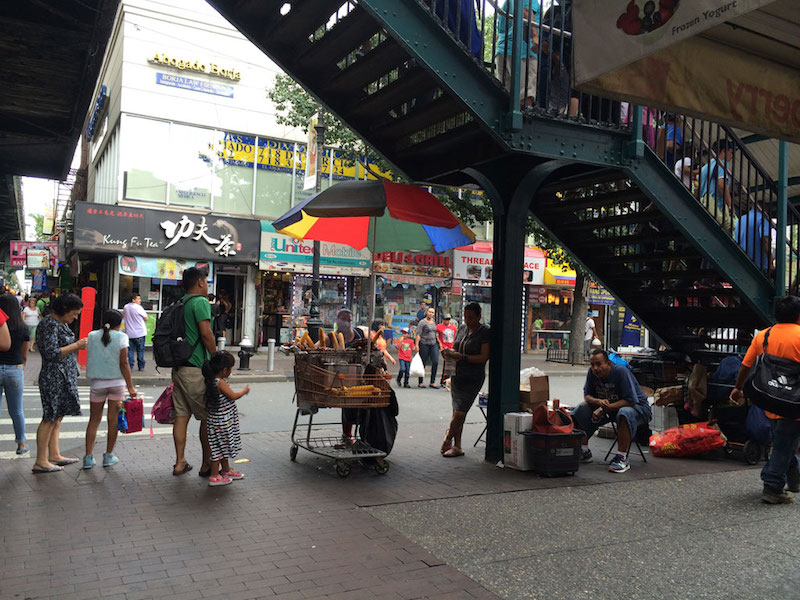
Tamales sold streetside by the basket are among our favorite treats in Queens. The countless kinds of ethnic cuisine found in the borough and the people that lovingly cook it are what make it great.

The church at 69th Street and Roosevelt Avenue, photo by Sarah Khan

(Editor's Note: The ill anti-immigrant and -refugee wind blowing out of the White House in Washington, DC, does not represent the America we know, nor does it speak to our experience exploring the world’s culinary backstreets. The cities and countries where we work – the United States included – have always been havens for those looking for a better, safer place. All have come with their food, making their new home a truly better place for us all and becoming an indispensible part of its fabric in the process. In their honor, this week we are running some of our favorite archived stories of immigrants and refugees who have left a culinary mark on their adopted land.) If you walk the length of Roosevelt Avenue from 69th Street to 111th Street in the early morning, you may encounter up to two dozen tamale ladies, usually at the major intersections that correspond to the 7 train’s stops.

Vino Underground

Ènek poured a rosy-colored splash of wine into our glasses, avidly explaining how this particular Aladasturi grape vine was meticulously cultivated in its native west Georgia. In a tasting ritual uncommon in Georgia, we swirled it, sniffed it and savored the flavor as it caressed our tongues. Here in the “cradle of wine,” the land where viticulture is believed to have originated 8,000 years ago, wine is customarily poured into a water glass and “tasted” in one long drag, until drained. But in this cozy cellar in the heart of Tbilisi’s historic Sololaki neighborhood, seven winemakers have come together to offer an alternative convention to winemaking and consumption. They call it Vino Underground, but we call it wine heaven.

Imported image from WordPress content

Berlin Wall No2 is a rickety wood and plastic-sheeting structure on the pavement right on the Greek-Cypriot side of the “green line,” as the border that divides the Cypriot capital is known. It’s overlooked by guards and is a five-minute stroll from the more stylish eateries in the center of Nicosia’s Old Town. But this little hole-in-the wall serves the best sheftalia we’ve eaten in the city. You could argue about whether these wonderful little nuggets are a form of sausage – what the French would call crepinettes. Two cuts of pork – backfat and loin – are minced, mixed with onions, herbs and seasonings, then encased in caul fat – the membrane that surrounds a pig’s stomach – and grilled over charcoal.

logo

Terms of Service