Latest Stories

Queens: A Street Food Paradise

On our culinary walk in the borough, you'll quickly realize that Queens is not just a paradise for different ethnic cuisine but also for street food! Approach with an empty stomach.

Central de Cacao

Entering Central de Cacao, one might think it any other café in the hip neighborhood of Roma Sur. Sitting upon stools, customers hunch over their laptops, sipping from steaming mugs. A wide, beautiful geometric design hangs on the high wall behind the counter. To the left of the entryway, colorful products for sale line a stack of long shelves. But upon closer inspection, the sweet nature of the cafe and store reveals itself. The contents of the steaming mug: chocolate. The geometric design behind the counter: molinillos, or traditional Oaxacan chocolate whisks. The products on the shelves: all chocolate. Chocolate-infused honey. 100 percent chocolate bars.

Imported image from WordPress content

What the taco stand is to Mexico City or the wok-wielding hawker to Bangkok, the Würstelstand is to Vienna. At any time of day or night, people line up to snack on a quick sausage, with a pickle, mustard and a can of beer. There is an astonishing variety of sausages to choose from – from well-known Vienna sausage to Waldvierter, a twice-smoked sausage made from pig’s head, from spicy Burenwurst to Käsekrainer. The last one is for many locals the king of the Wurst: a coarse sausage filled with pockets of hot, melted cheese that ideally form a crispy crust on the outside once the sausage has been grilled.

Apples and Oranges in Tbilisi

Boxes of apples about to be put for sale at a kiosk at Tbilisi's Deserter's Bazaar, which is packed with interesting and tasty wares and is the focal point of our walk in the city. (Photo courtesy of David Greenfield)

Kalango

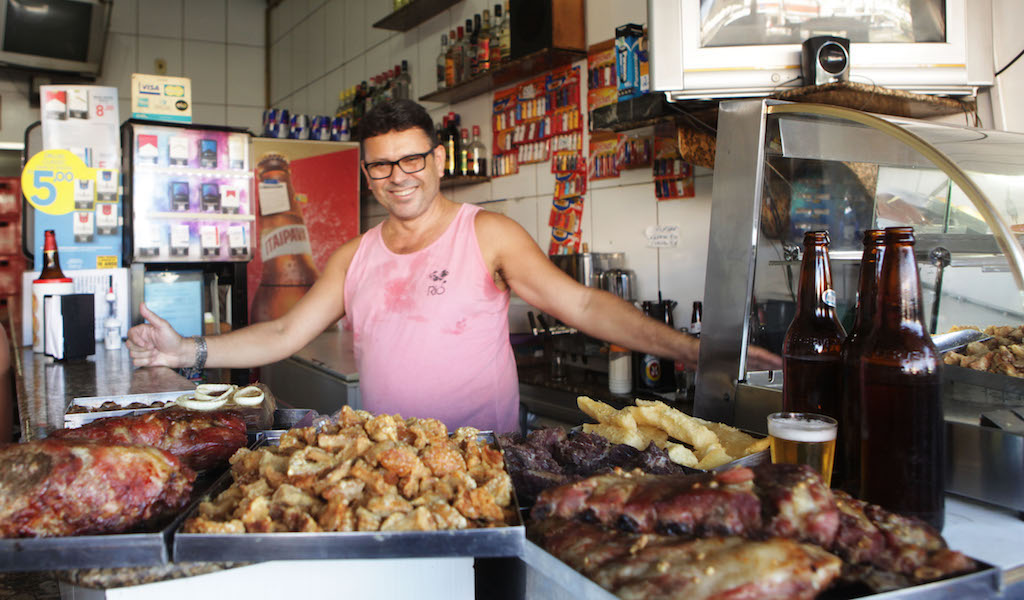
The calango is a tiny lizard commonly found in the hottest, driest and poorest parts of Brazil’s Northeastern countryside, and in popular culture, the calango is also a symbol of hunger. Someone who eats calango is driven to do so because he has nothing else to eat. Thankfully, at Kalango there’s plenty to eat. Kalango (the “K” is for chef Kátia Barbosa, owner also of Aconchego Carioca) is a spartan botequim, or small gastropub, located near downtown that serves the specialties of Brazil’s Northeast states. This comida sertaneja, as it’s called, is very hard to find in Rio.

Athens' Suburban Gem

As you approach Maroussi by train, it is difficult to imagine that 100 years ago it was full of mansions with lush gardens – some still standing today – olive orchards and vineyards. Situated 13 km north of Athens, Maroussi (AKA Amarousion) was the home of Spyros Louis, the first athlete to win the modern Olympic marathon event in 1896. It is also where the modern-day Olympic Stadium and sports complex are situated. The train was connected to Maroussi in 1885, when it was also known as “the beast,” and it took three hours for the beast to make the trip from Omonoia.

El Racó del Mariner

There are certain places that experience the strange phenomenon where everything and nothing change at the same time. Take the example of El Racó del Mariner (The Sailor’s Corner), located for 40 years at the old fishermen’s dock in the port of La Barceloneta until it was forced to move when the area was turned into a marina for luxury yachts. Regardless, even at its new address in the modern Port Fórum area, reaching El Racó del Mariner requires that you cross a port police checkpoint, just as you had to at the old spot.

Atila del Sur Comedor

Oaxaca, consistently ranked as one of the three poorest of Mexico’s 31 states, can also claim the title of having the country’s worst school system. Demonstrations and rallies by students, teachers and unions are a regular occurrence in Oaxaca City, causing frequent gridlock in the center of town. The walls of the city in bold graffiti reflect the young voices of the social movement: sometimes, a mere angry scrawl, but more often, these are canvases that will move you to pause and consider these depictions of revolution, past and present. One such wall is on Calle Porfirio Diaz in the Centro Histórico. It’s the exterior of Espacio Zapata, the home of the Asamblea de Artistas Revolucionarios de Oaxaca (ASARO).

Tonkatsu Hamachan

When Tonkatsu Hamachan first opened in 2001, it became an industry favorite – one of those places chefs, foodies and lifestyle journalists kept to themselves. Perhaps they closely guarded this spot because the dining room barely fit six tables, most of which were usually occupied by Japanese businessmen. The restaurant itself refrained from self-promotion – the shoji screen with hiragana script and a frosted glass door would have been as illustrative as a blank canvas to the mostly Japanese-illiterate pedestrians in the expat-friendly enclave of Jing’an. We lived just two blocks away from Hamachan for over a year when we first moved to Shanghai in 2007 and didn’t know about the tonkatsu genius until a friend drunkenly whispered the secret to us one night.

Fumeiro de Santa Catarina

Though it’s an age-old method for preservation and flavor enhancement all over the world, the smoking of meat, fish, and cheese is not a notable tradition in southern Europe. In Portugal, in the old days, salt curing was more common – particularly for the national staple, cod. However, the presence of smoking traditions in the north, particularly around the Minho river, indicates the possibility that the Vikings’ favorite method for cooking fish may have reached all the way to the northeastern Iberian peninsula.

Marani

Georgians – that is, Georgians who hail from the former Soviet republic and not the American South – love their cheesy khachapuri and their beef-and-lamb-filled khinkali. At a glatt kosher restaurant, however, dairy items and meat items can't mingle, either in the kitchen or in the dining room, and many such establishments serve only one or the other. Marani takes a second approach: two kitchens, two dining rooms, two sets of dishes. It's possible to enjoy a progressive dinner under a single roof, first with khachapuri in a basement bakery that resembles a spartan pizzeria, then with a succession of appetizers, skewers and entrees in the more formal setting upstairs.

El Bisaura

Inside Barcelona’s lesser-known Mercat de Les Corts is a small, unassuming bar offering up the bounty of the Mediterranean. El Bisaura opens up shop at 6:30 a.m., serving esmorzars de forquilla (hearty Catalan breakfasts like sausage and beans, tripe stew and grilled cuttlefish) to local workers. At lunch, it serves a more refined seafood menu composed of whatever owner Alfonso Puig gets from Peixateria Anna, the fish stand on the other side of the market. The fish and seafood of the day are always seasonal, local and impeccably fresh – which is no surprise, since Puig is also the owner of the fish stand.

Lucio, photo by Francesca Savoldi

Sitting at a table in Lucio, a long-established tavern in the heart of Madrid’s most famous tapas street, is a singular experience that has a slightly surreal, Buñuel-esque touch. Queues formed of Madrid’s born-and-bred elite snake past the elegant wooden bar, the coiffed connoisseurs greeted with affection by the landlord himself as they wait to eat his restaurant’s specialty dish. Lucio’s signature white suit and the hushed, apparent dignity of the place are quite a contrast to the actual holy grail itself: a plate of fried eggs and fries. The eponymous owner keeps repeating in a whisper that this is the most famous restaurant in all of Spain; perhaps it truly is.

Biscoito Globo

Asking cariocas if they remember their first Biscoito Globo, the ubiquitous, crunchy beach snack, is like asking anyone who teethed in the United States if they remember trying Cheerios for the first time. Globo biscuits and sweet iced mate are to Rio's beaches what hot dogs and beer are to American baseball stadiums. Calls of “Ó Globo! Ó mate!” are the soundtrack along the shores of Copacabana, Ipanema and Leblon. The iconic packaging, which features a globe-headed mascot surrounded by the Eiffel Tower, the Tower of Pisa, Portugal's Belém Tower and Rio's Sugarloaf, has been reproduced on t-shirts, tote bags, and cangas (sarongs).

Post-Colonial Lisbon: Angolan Edition

Although Angolans are not known to emigrate en masse like their continental counterparts, they do form the second largest African diaspora community in Lisbon. The seventh largest country in Africa, Angola has undergone considerable upheaval, which has contributed to this. Violent civil conflict began after the country gained independence from Portugal in 1975 and continued – with a few interruptions – until 2002. Caused by a power struggle between two former liberation movements influenced by the larger cold war, this conflict has caused half a million deaths, significant displacement and severe damage to national infrastructure, stoking a steadily burning atmosphere of social instability and insecurity.

logo

Terms of Service