<p><span style="color: rgb(0, 0, 0)">Somsak Pu Ob serves a single specialty: glass noodles steamed in individual steel pots with prawns or crab, pork lard, scallions and sam kler. Nai Somsak personally oversees each pot, judging the seafood’s cooking time with decades-honed precision.</span></p>
Built to Last: Bangkok’s Long-Running Food Institutions


<p>What began as a noodle cart more than 50 years ago has become a three-generation family business tucked behind Bangkok Hospital’s cardiac care building. Look Chin Anamai specializes in clear, deeply beefy broth with tender cuts of meat, liver, and springy, flour-free meatballs. Order the <em>ruam mit</em> for a little of everything, adding a spoonful of pickled chilies in vinegar, and don't miss the grilled meatball skewers. Arrive early to beat the crowds.</p>

<p>Nearly five decades old, this alleyway noodle shop on Sukhumvit Soi 20 is a rare survivor of an older Bangkok, drawing loyal regulars for its tender stewed chicken wings, rich broth, and excellent <em>yen ta fo</em>. Khun Saowarot has built a following for her chicken-wing noodles, served with a choice of noodles. Named after the street's former name, Sainampung, the shop remains a neighborhood fixture despite the changes that have transformed the surrounding area.</p>

<p>What began as a Chinatown noodle cart in the 1960s has grown into one of Yaowarat's most beloved institutions. Founder Nai Ek opened his permanent restaurant in 1989, specializing in <em>kuay jap</em>, rolled rice noodles swimming in a punchy, peppery, garlicky pork broth. Order a bowl loaded with crispy pork belly, liver, tongue, stomach, kidney, and minced pork patties, a combination that has kept customers coming back for generations.</p>

<p>A longtime fixture near Bangkok's Victory Monument, Toy Kuay Teow Ruea specializes in <em>kuaytiaw ruea</em>, or boat noodles, traditionally sold from boats along Thailand's canals. The tiny bowls pack a punch, particularly the beef <em>naam tok</em>, a dark, spicy, tart broth enriched with a splash of blood and filled with rice noodles, braised beef tendon, sliced beef, and a meatball. One bowl rarely suffices; it's customary to order several.</p>

<p>Founded in the 1950s by the current owner's grandmother, Khun-Yah Cuisine is one of Bangkok's surviving old-school curry stalls, tucked into the parking lot of Wat Traimit in Chinatown. Stainless steel trays display traditional central Thai dishes, including a standout green curry with beef simmered in coconut milk until tender. The cooking favors subtle, balanced flavors over fiery heat, preserving a style increasingly difficult to find in Bangkok. Arrive before 11 a.m., when most dishes have already sold out.</p>

<p>Opened in 1970, Sanguan Sri has barely changed while Bangkok's high-rises, luxury hotels, and shopping malls have sprung up around it. Founded by Miss Sanguansri, the modest restaurant on Wireless Road still has its original 1970s furniture and serves traditional Thai dishes that are increasingly difficult to find elsewhere. After the founder died, her longtime staff kept the kitchen running. Come for the rotating daily specials, particularly the green curry with beef, and a taste of old Bangkok.</p>

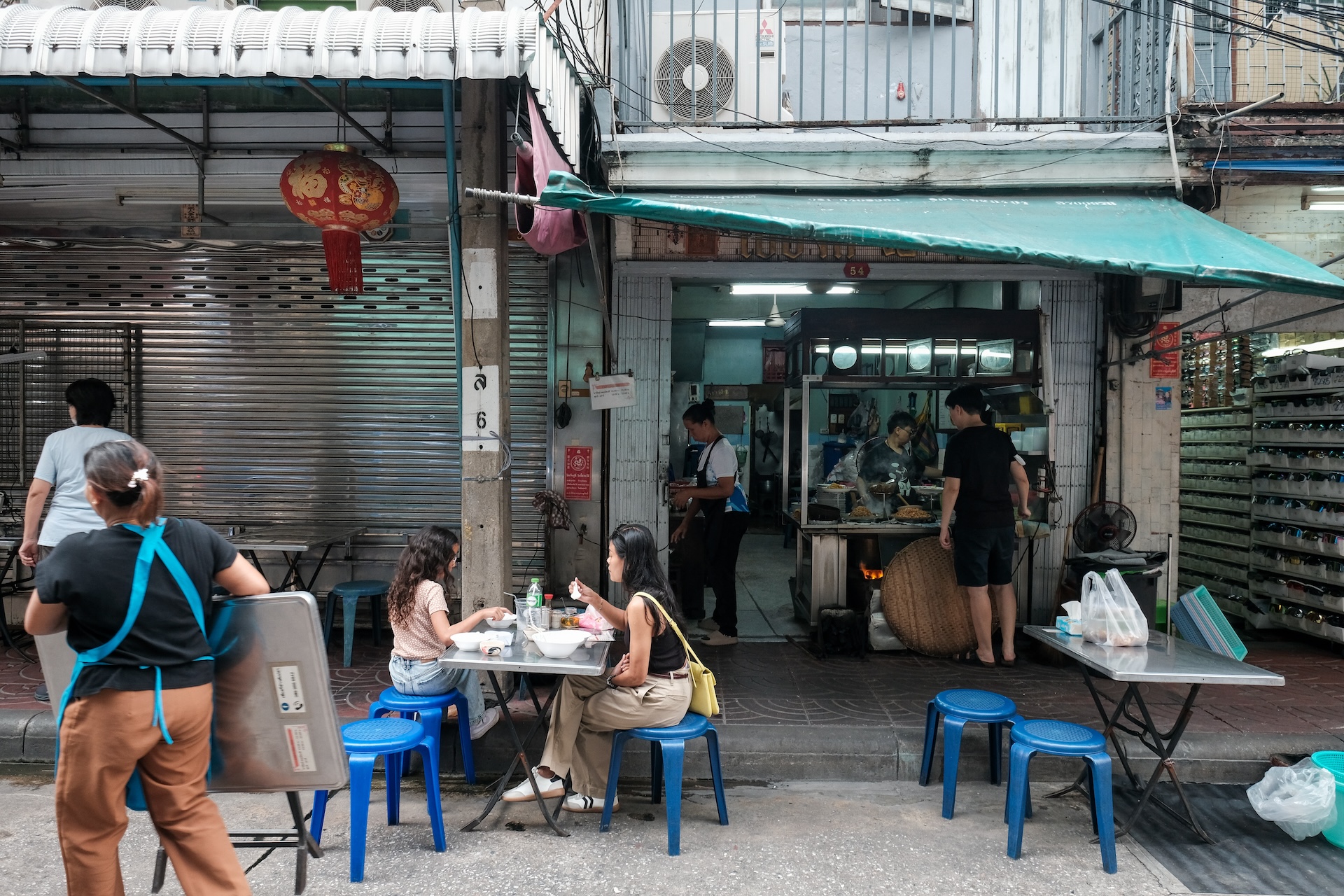
<p>For more than three decades, this Chinatown shophouse has specialized in <em>hoi tod</em>, Thai-style oyster omelets with roots in Teochew Chinese cooking. Founder Mr. Mong's recipe has been passed down to an apprentice, who continues to turn out the restaurant's signature crispy omelets, packed with plump oysters and fried until golden and crunchy around the edges. There's also a softer, chewier version, but the crisp, wok-seared original is the one to order.</p>

<p>Named for its founder, Mae On, The Original Mae On’s Curry Rice has been a fixture of Bangkok’s Saphan Han neighborhood for more than 50 years. The family-run <em>khao geang</em> shop, near Chinatown and Little India, begins preparing food at 4 a.m., filling silver trays with curries, stir-fries, and regional specialties. Unlike most <em>khao geang</em> shops, where dishes are served over rice on a single plate, Mae On’s encourages sharing, with small plates for mixing and matching. Regular favorites include <em>moo waan</em> (sweet pork), <em>moo khem</em> (salted pork), and <em>khai khem puu jaa</em>, a fried pork-and-crab meatball with a salted egg yolk center. There are also harder-to-find dishes, including northern Thailand’s <em>nam prik ong</em>, a tomato and minced pork chili dip. The generous selection and welcoming atmosphere have made Mae On’s a longstanding favorite for locals seeking a quick, satisfying meal.</p>

<p>For nearly a century, this family-run Chinatown institution has specialized in <em>khao tom pla</em>, a traditional Chinese-Thai rice soup with fresh fish. Tucked into an alley off Charoen Krung Road, Siang Ki has passed through generations while preserving its old-school cooking methods. The signature bowl features tender slices of pomfret in a delicate, aromatic broth, with additions like oysters or <em>bateng</em> (soy-braised pork). It's a rare surviving example of Bangkok's early Chinese-Thai dining traditions.</p>

<p>At Ban Wannakovit, Apavinee “Taew” Indaransi welcomes diners into the same Bangkok home where three generations of her family grew up. Built by her great-grandfather, who worked in the royal court of King Rama VI, the gingerbread-style mansion now doubles as a restaurant specializing in dishes that have all but disappeared from the city's menus. It's a fitting stop on our <a target="_blank" rel="noopener noreferrer nofollow" class="text-[#781e2a] underline" href="https://culinarybackstreets.com/food-tours/bangkok/backstreet-bangkok-exploring-the-cradle-of-thai-cooking">"Backstreet Bangkok: Exploring the Cradle of Thai Cooking tour,"</a> offering a glimpse into a side of the city's culinary history that's increasingly difficult to find. Taew is particular about the details, whether it's sourcing fragrant bitter oranges for <em>mii krawp</em>, crispy rice noodles in a sweet-and-sour sauce, or preparing <em>khao chae</em>, flower-scented rice served in ice water with an elaborate assortment of accompaniments. Some recipes come from her grandmother, while others have roots in the royal kitchens of old Siam. For Taew, the family home is as much a place to share these dishes as it is to keep them alive.</p>

<p>Serving breakfast since 1933, On Lok Yun has survived more than 90 years of change in Bangkok while keeping its old-school charm intact. Tucked into a shophouse on Charoen Krung Road, this family-run institution specializes in Thai-style Western breakfasts: eggs with ham, bacon, or Chinese sausage, thick French toast, and steamed bread dipped in sweet coconut <em>kaya</em> custard. Vintage furnishings, whirring ceiling fans, and long morning queues complete the experience.</p>