S M B O measurement-vertical measurement-vertical

Latest Stories, Porto

The lunch rush at Tasquinha Zé Povinho in Porto, photo by Ricardo Castelo

When the late 19th-century Portuguese artist and cartoonist Rafael Bordalo Pinheiro wanted to create a vehicle through which to mock and criticize the country’s powerful elite, he settled upon the character Zé Povinho, an unsophisticated country laborer who served as a stand-in for the average citizen. While some Portuguese people took umbrage with their country’s everyman being depicted as a simple peasant, time has softened this criticism, and Zé Povinho has become something of a national icon. “Little by little, we started to see him with a certain tenderness, as a symbol of the Portuguese identity, a reminder of where we came from,” says Andrea Salomé, a restaurant owner in Porto.

Adega Vila Meã

Carla Santos is a busy woman. On the day we go to meet her, it is pouring rain in Porto and Adega Vila Meã, the restaurant she runs, is full. Carla doesn’t stop for a second: “One of those pork firecrackers with potatoes?” she asks a customer as she swings through the dining room. She’s not alone in this mad dash. Carla works the tables with her youngest daughter, while the oldest, who learned how to cook from her mother, mans the kitchen. Even Carla’s 7-year-old granddaughter helps out, clearing tables. “It costs nothing to start learning right now,” says grandma Carla, already certain that “we are moving Adega from one generation to the next.”

The francesinha, photo by Francesca Savoldi

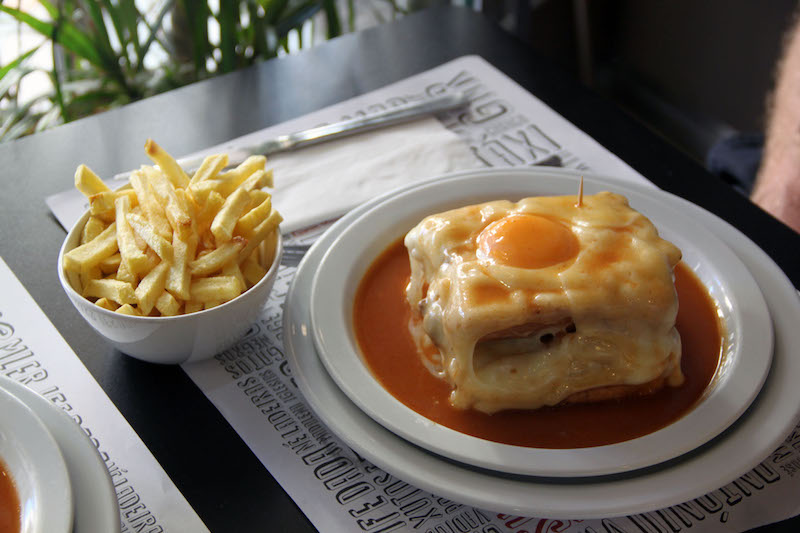
A gloppy, meaty, cheesy brick served in a pool of sauce and with a mountain of fries: please meet the francesinha, the culinary pride and joy of the city of Porto. Today, restaurant billboards proclaim in many languages that they serve the best version in the world, revealing the genuine power of this artery-clogging combination that, incredibly, was originally conceived as a snack. We have to say it though: eating a francesinha is worth every last calorie. This dense sandwich, which is impossible to eat just with your hands, is often considered the lusophone version of the croque monsieur.

Almeja

Thirty-year-old João Cura and his wife, 29-year-old Sofia Gomes, may be young but they have long had a wish to open their own restaurant. Yet it was never totally clear where or when they would fulfill this dream: both are originally from Coimbra, a city in central Portugal, and worked for years in Barcelona. The couple finally found a perfect spot, in Porto of all places, to open Almeja, which fittingly means “to want or to wish for something very much” in Portuguese. Talk about a dream come true.

Best Bites 2018

After being named Best European Destination in 2017 and earning a few other tourist distinctions, there’s no doubt about it: Porto is trendy. But what’s trendy is also in Porto, and those who live here see new restaurants pop up every week. We try them all – places both bold and familiar – because we have a good appetite, but we put our trust in those spots where we get the warmest reception. And trust is something we take very seriously in Porto. Homey meals at A Cozinha do Manel Open now for three decades, A Cozinha do Manel is far from the touristy downtown and serves up good old comfort food, the type of fare that leaves us serenely satisfied.

A Cozinha do Manel

The sensation of entering A Cozinha do Manel (“Manel’s Kitchen”) in Porto is so similar to entering grandma’s house on Sunday that it almost confuses us. There is no one to greet you at the door, no cloth napkins folded over employees’ arms. We walk confidently, as we would at home, with the sense of comfort that only intimacy is capable of inspiring. From the wall, among the many clocks, vintage plates and drawings made on cloth napkins by customers with an artistic bent, dozens of familiar faces look back at us. They are actors, musicians, politicians and soccer stars all standing next to Zé António, the owner and manager – a confirmation of the restaurant’s popularity.

Porto Does It Better (In Some Cases)

There has always been a bit of a rivalry between the two main cities of Portugal, Lisbon and Porto, which is well illustrated by an old running joke among some tripeiros (the name given to the people of Porto): whenever someone asks what is the best thing about Lisbon they will reply, “The highway sign that says ‘Porto.’” But it’s a healthy rivalry for the most part – football aside. Lisboetas, Lisbon locals, in general even tend to recognize that the food might actually be better in Porto and its surroundings, especially traditional dishes. While Porto does not benefit from the same multicultural influences that helped shape Lisbon’s restaurant scene, it is home to some very talented cooks with a knack for doing so much with so little.

The open kitchen at Taberna dos Mercadores, photo by Francesca Savoldi

Seating around only 20 people, Taberna dos Mercadores is a microcosmic reflection of contemporary Porto: a mixture of high-concept design and traditional food. From a design perspective, the focal point of the small yet comfortable dining room is the ceiling, where white metal supports create the outline of a false dome. Although sculptural in nature, the distinctive design is not merely ornamental but also practical: it doubles as a wine rack, cradling neatly stacked rows of bottles. Wine buffs will be satiated at the diverse but humble selection on offer here, which mainly originate from the Douro valley, the sumptuous growing region that extends from Porto along the Douro River all the way to the eastern border with Spain.

Fishmonger Maria Adelaide, photo by Francesca Savoldi

Matosinhos, a small city just north of Porto, is used to change. It has an industrial air to it, due to its 19th-century harbor, and its past prosperity was connected to the fish-canning sector, which peaked during World War II and declined from the beginning of the 70s. The numerous abandoned warehouses attracted nightlife during the 1990s, with clubs finding a fertile zone for noise. The completion of the long-delayed tidal pool, built by Portugal's starchitect, Alvaro Siza (who was born in the city), put it firmly on the map again after the project was delayed for decades. In January, the launch of the new, spiralling cruise ship terminal added to the contemporary design-y feel that has been developing on its otherwise rugged coastline.

logo

Terms of Service