S M B O measurement-vertical measurement-vertical

Latest Stories, Porto

Caldo Verde

Caldo verde, Portugal’s most famous soup, doesn’t sound like much in English – “green broth” is the literal translation. I was thinking about this when reading an article on the 20 best soups in the world, which a friend sent to me, noting that caldo verde (a “homey soup” where “thinly sliced greens meld with potatoes and onions”) had made the cut. The article refers, in general, to the restorative power of soup, a belief that is held in very different cultures across the globe – which sounds about right to me. But then the author references a book that broadly defines soup as “just some stuff cooked in water, with the flavored water becoming a crucial part of the dish.” And I have to disagree there, because caldo verde is so much more than flavored water. How to explain that it is a feeling?

Gito wine bar, Porto, photo by Rafael Tonon

For a city famous for making one of the best-known wines in the world, it took Porto a long time to catch up with viable options for bars offering good glasses. But Portugal's second-biggest city has finally reached an effervescent wine peak that lives up to its worldwide fame – not to mention the country is now the world's leader in wine consumption, at around 58 liters per capita. Today, bars in Porto are wildly different from days past: their wine-by-the-glass lists feature many small producers and venture away from conventional bottles, they have young chefs in the kitchen taking a more international approach to their menus (with influences from the Middle East to Latin America), and offer service that is both professional and welcoming.

Stramuntana: Northern Exposure

It’s a warm summer day, yet inside Stramuntana, a restaurant in Porto devoted to the cooking of Portugal’s northern Trás-os-Montes region, a hearth is blazing. “In the past, people in Trás-os-Montes used wood-burning ovens all year,” says Lídia Brás, Stramuntana’s co-chef and co-owner, when we express our surprise in seeing a fireplace in operation during the hotter months. “There was no electricity or gas. Everything here is thought through to be authentic." It’s a small lesson in the foodways and culture of Portugal’s northernmost region, as well as an illustration of this restaurant’s deep dedication to authenticity.

Guindalense FC: Where It’s Always Festival Time Featured Image

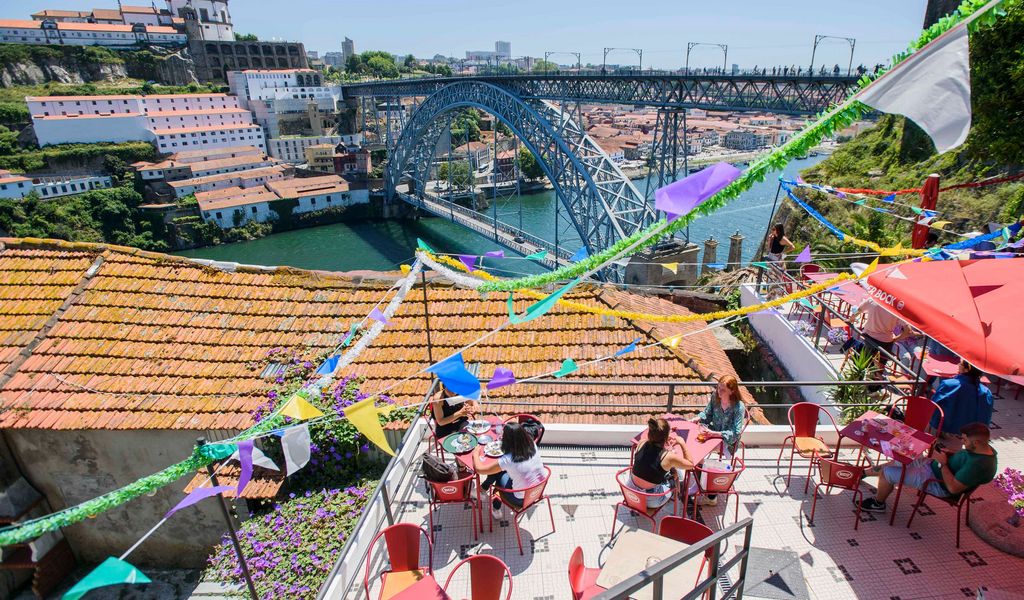
Those returning to Porto along the Luís I Bridge will notice a set of terraces to their right decorated with colored garlands, flags and string lights, as if someone forgot to take down their decorations after the June 23 São João festival, the city’s largest celebration. The garlands and flags stay up all year, though, and are the easiest way to find one of Porto’s most interesting hidden gems: the Guindalense Futebol Clube, home to some of the city’s best views. The story begins, at least officially, in 1976, when the club was founded as a place for amateur footballers and other athletes in the Guindais neighborhood.

Cured hams hang from the ceiling at Casa Louro, a bar/restaurant in Porto, photo by Austin Bush

When we arrived, there were one or two customers quietly drinking wine at the bar. Later, a man entered and bought cured ham by the kilo, complaining about how much fat it contained. A food tour stopped by, filling the silence with English-language explanation. A bit later, the mailman stuck his head in; he had no letters to deliver, but it was clear that he was angling for a drink. The clientele that late morning at Casa Louro, a bar and restaurant in Porto, seemed to be a microcosm of the city’s life. Indeed, with hams hanging from the ceiling, soccer paraphernalia on the walls, and crusty old customers, it looks like the quintessential Portuguese bar. And in many ways it is, but Casa Louro is also something of a dying breed.
O Buraco: In the Trenches Featured Image

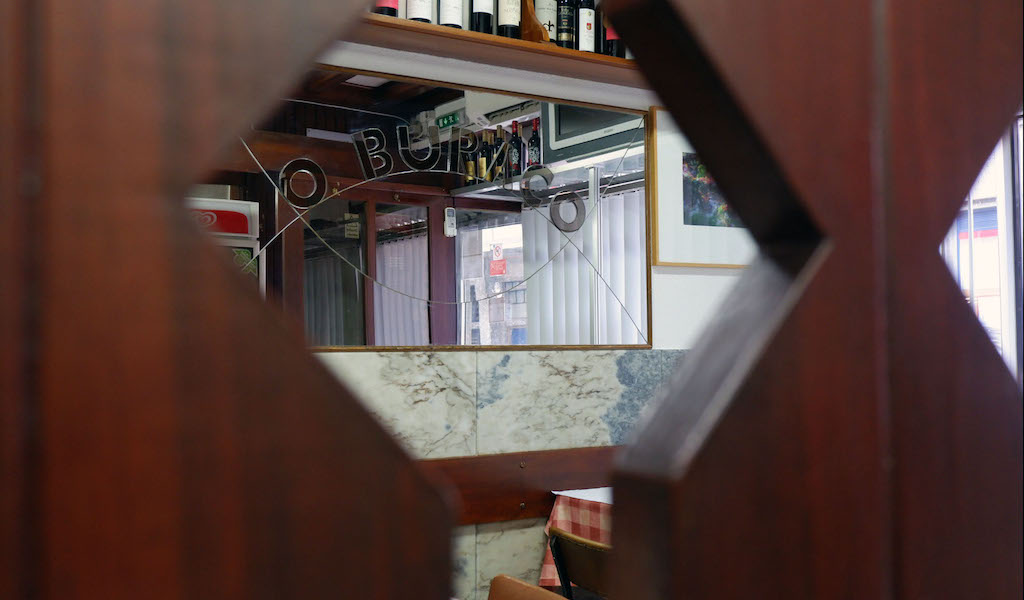
Manuel Azevedo and Francisco Moreira, now both in their 70s, have been friends since childhood. Such a close connection has afforded them the trust and togetherness required to run O Buraco, the restaurant in Porto that the duo have presided over like generals for almost 50 years. In fact, it was right after completing his military service that Manuel, a native of Marco de Canaveses, a city within the greater Porto municipality, came to Porto proper in search of work. “I picked up the newspaper, saw the ad, applied and was hired as a waiter,” he tells us. On February 4, 1971, he entered O Buraco (“The Hole” for the first time; he hasn’t left since.

CB on the Road: The Culinary Magic of the Tabernas do Alto Tâmega Featured Image

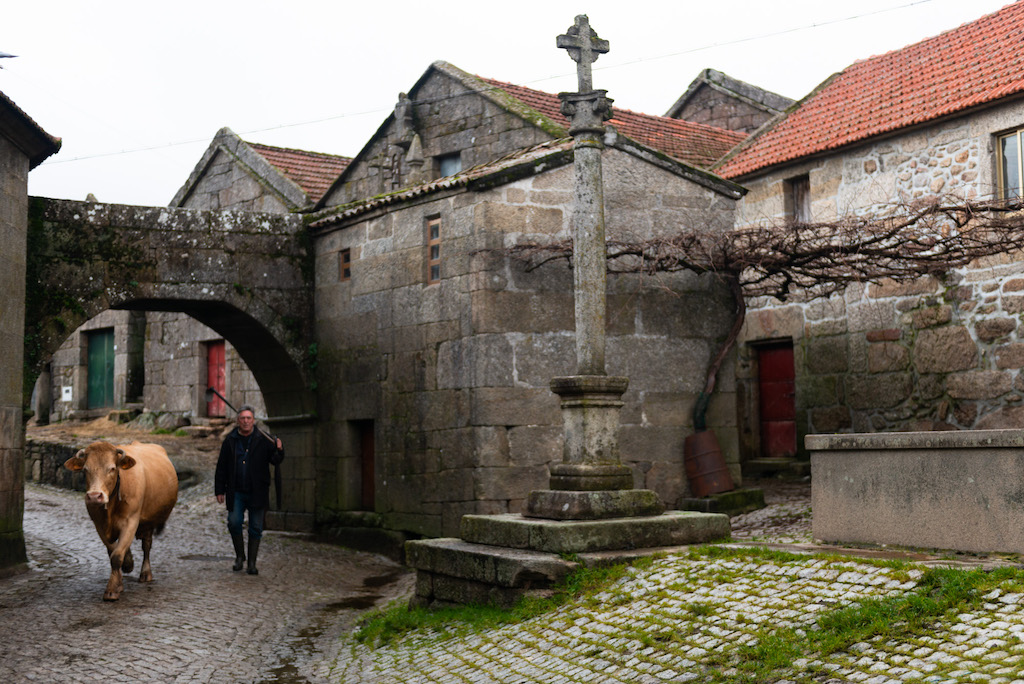
We weren’t entirely sure if we were in the right place. Upon reaching the summit of a comically steep driveway, Casa de Souto Velho appeared more private home than restaurant. And even if this was indeed our destination, we had not made a reservation. Nonetheless, and despite having a virtually full house, Eufrásia Almeida welcomed us inside, and within seconds our table was loaded with a bottle of wine made from local grapes, a plate of house-made preserved meats, and a basket of house-baked bread. After lunch – more on that later – her son Pedro showed us around the garden, the chicken coop, the pig pen and the smokehouse, and even drove us to see the family vineyard. Regardless of where we had arrived, we were, we felt, at home.

Queijaria da Praça: The Green Cheesemonger

Queijaria da Praça sits in the Praça do Marquês neighborhood, in a cozy space where the temperature does not exceed 15ºC and the pungent aromas of cheese penetrate the nose as soon as one steps in. “When we opened, we wanted the store to be here,” owner Diana Guedes says. Far from the tourist areas of Baixa or Ribeira, crowded with visitors and more mass-market shops, the Praça do Marquês neighborhood is one of the best examples in Porto of bringing together a balanced mix of shops and residential buildings. “As we have many buses and a metro line, it is a crossing point for many people, which is very interesting for us, of course,” she explains. The location also helps to attract a more niche public of connoisseurs.

Best Bites 2022: Porto

After a couple of harsh years, Porto's culinary scene is finally coming up for air again, as in many other places in the world. It is undeniable, however, that the pandemic shook things up a bit, influencing the local scenario: we’ve seen more casual venues opening, and some traditional restaurants closing for good. But the overall balance has been good for the city and it’s been fascinating to see its evolution, with new projects taking shape and others that have been given the chance to establish themselves.

It’s Back: Porto’s Beloved Mercado do Bolhão Reopens

It took four years and four months, but Mercado do Bolhão, Porto’s central market and historic icon, finally came back to life in September. The first to arrive at the reopening was Nossa Senhora da Conceição, the market’s patron saint, whose image was installed in front of the new structures that are now part of the centenarian building. Located at the entrance to the grand market, which measures more than five thousand square meters, the saint's image welcomes the visitors who have filled the new space every day since the doors finally opened.

Confraria da Rabanada: Porto’s Brotherhood of Bread

Wearing a light beige cape down to their feet with an R embroidered in golden threads on the left side of the chest (an outfit which would make even Harry Potter jealous!), a group of young adults hug each other, pose for photos, and take selfies with their smartphones. They are getting ready to step into the theater of the Ateneu do Porto, a room with rococo decor, dark red velvet curtains, and wood carved in adjoining designs painted in gold, which has hosted some of the most important national and world artists here in the second largest Portuguese city. By the clothes and the pomp of the event, one could predict that something important is happening.

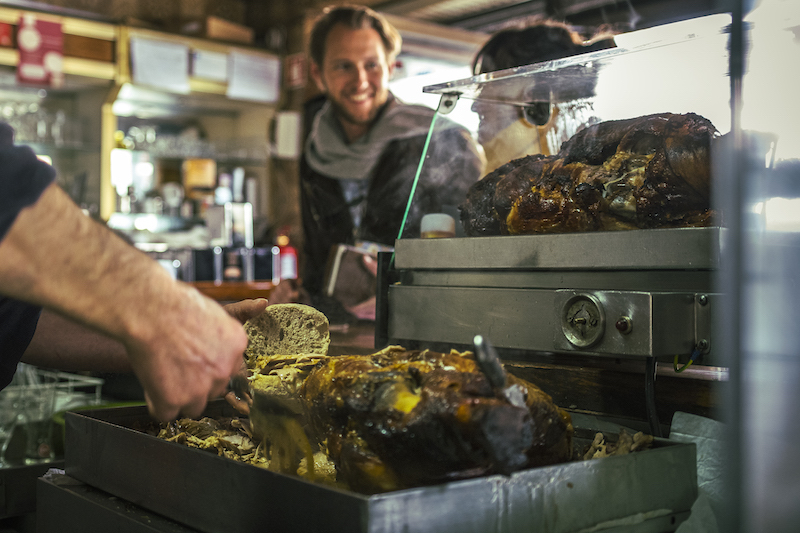
Preparing the sande de pernil (roast pork sandwich) at Casa Guedes, photo by António Morais

Forget the famous francesinha. The best sandwich in Porto – arguably in the country – can be found in a little 1970s tile-lined eatery; the unremarkable interior belies the iconic status of its most celebrated dish. Served up on the corner of Praça Poveiros, a square named after the fishermen from the storied maritime city Póvoa de Varzim, located just north of Porto, the sandes de pernil (roast pork sandwiches) are a curious joy to watch being assembled as well as, of course, to eat. One by one, roast pork legs are slowly cooked in the huge oven in the kitchen behind the bar of Casa Guedes. They are then served directly from the roasting tray by the owner himself, Mr. Cesar.

O Astro Cervejaria Petisqueira

Just like at Porto’s central Campanhã train station on Rua da Estação, O Astro Cervejaria Petisqueira on the other side of the street is reliably crowded every day. Its strategic location near the station helps account for that. But what really draws the crowds in is O Astro’s reputation as a must-stop for the definitive take on the bifana, one of Porto’s signature sandwiches. Much like the train station, O Astro brings locals and visitors together from all over Portugal, in search of one of Porto’s essential bites. At the most elemental level, the bifana is a pork sandwich, and in its most traditional form it includes thin slices of braised pork shank tucked into a crusty roll called a carcaça.

Cantina 32: Porto Trailblazer Featured Image

The restaurant that Inês Mendonça dreamed of can only be described using the Portuguese expression levantar as pedras da calçada – literally, to raise the stones from the sidewalk” –to create something totally new and groundbreaking. When Porto’s now-popular Ruas das Flores was being restored, the din of construction clanging as workers labored to turn it into a pedestrian-only thoroughfare, Inês was seeing miles ahead. It was there that her restaurant would open its doors, she decided, and it would be a place different from all the rest – relaxed and full of curiosities.

Best Bites 2021

Much like 2020, this year was marked by the shadow of the Covid-19 pandemic, which took over the city's restaurant scene. While there were some glimpses of normalcy here and there, the fact remains that Portugal’s year started with a new lockdown that forced Porto restaurants to totally close their doors in February. It was deja vu almost a year on the dot. Some of these eateries never reopened: The recently inaugurated Esporão no Porto was one of them. The first project outside Alentejo of the renowned winery Esporão (whose restaurant of the same name just received a Michelin star) didn't even last a year in the city. The Astoria, a city landmark restaurant in the luxury Hotel InterContinental also announced its closure.

logo

Terms of Service