S M B O measurement-vertical measurement-vertical

Latest Stories

CB Book Club

Tiko Tuskadze, chef-owner of London’s celebrated Little Georgia restaurants, with one branch in Islington and one in Hackney, shares her love for the food of Georgia, her home country, in her first book, “Supra: A Feast of Georgian Cooking.” The book, which was published in the U.K. in summer 2017 and in the U.S. and Canada in summer 2018, features the recipes and stories that have been passed down through her family for generations. We recently had the chance to chat with Tuskadze and hear more about her career trajectory, the work that went into creating Supra and the role that food played in her childhood in Georgia.

Taverna a Santa Chiara

Take a small space in a strategic location, add two young and idealistic owners, and finish with traditional Neapolitan dishes made with the finest raw ingredients – this is Taverna a Santa Chiara’s recipe for success. Everything began with the passion of two young Neapolitans, Nives Monda and Potito Izzo, for specialty artisanal food products from the Campania region. These types of products are not necessarily hard to find – Campania is home to many excellent small producers. Yet high quality often comes at a high cost, especially when compared to mass industrial products sold through large distribution chains.

Pomegranate Season in Tbilisi

It’s that time of year in Tbilisi when market stalls in the Deserter’s Bazaar are overflowing with pomegranates. Usually, a vendor will cut open at least one pomegranate to display the jewel-like seeds.

Bouz Al-Jidi

On a side street in Istanbul’s Fatih district, a neighborhood now brimming with Syrians, a small restaurant makes many passers-by do a double take – the 1960s-style façade looks like something straight out of Damascus. Upon closer inspection, they would see a man inside standing in front of a flame-kissed tandoor, the same one used to bake Damascene bread. When they read the name of the restaurant – Bouz Al-Jidi, the same name to crown a famous Damascene restaurant – it cements their hunch that they have found a gateway to old Damascus. The interior of the restaurant is decked out in traditional Damascene style, with a turquoise and dark green color palette and small wooden tables surrounded by wooden handmade chairs made of bamboo and straw.

In Full Bloom

For Josué Barona, the Mercado San Juan has always been part of his life: his mother and father both have stalls there, just around the corner from each other, and he has been working among the bustling food stands from a young age. While the stand that the now 35-year-old works at doesn’t really have a name – it is simply number 259 – many know it as Rosse Gourmet, the name he has given to the side of his business that sells edible flowers and micro greens. “We have been selling edible flowers for the last ten years,” he tells us as he counts colorful pansies into plastic containers ready for a big order he was preparing to send out. “Before that, the flowers didn’t exist [for sale] like this in Mexico.”

Tsukiji Market Is Dead, Long Live Tsukiji Market

It’s the end of an era for Tokyo’s Tsukiji Market. Saturday, October 6, will be the last day of operation for the world’s largest fish market, after which it will relocate two kilometers east to a new site on the manmade island of Toyosu. The move has been in the works for years (it was first announced way back in 2001), but with 2020 Olympic deadlines looming (the vacant site was a promised piece of infrastructure in the capital city’s bid to host), “Tokyo’s Kitchen” will be closing an 83-year chapter. As Tsukiji’s main wholesale marketplace is one of Tokyo’s few extant pre-World War II structures, darn near anyone you ask is sad to see it go. Tsukiji has a sense of place stronger than anywhere else in Tokyo, but ironically, the inner market has accumulated all of its site-specific charm in direct proportion to its decay.

A Taberna do Mar

The innovative chef Filipe Rodrigues, known for marrying Asian inspiration with Portuguese flavors, has finally opened his long-awaited restaurant, A Taberna do Mar (Sea Tavern), on a corner in the Graça neighborhood. Considering that 41-year-old Rodrigues has already ascended to a position of prominence thanks to his sardine nigiri, still one of the most iconic and innovative dishes in contemporary Lisbon, it’s no surprise that his new restaurant, the first that he will own outright, is focused on the fruits of the sea (as the name would suggest).

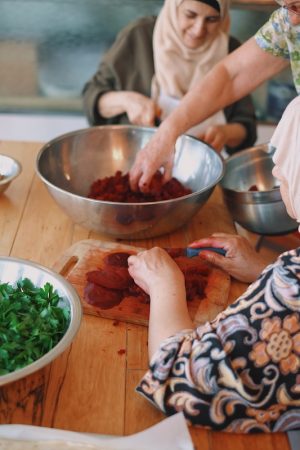
A group of Syrian women preparing beets for the weekly pop-up at Newcomer Kitchen in Toronto, photo by Mandy Sham

Every kitchen lives by its ebb and flow. There’s the gentle simmer of rote prep and small talk; the mad tango of searing sautés and the electric energy on the assembly line. Stray bits of sumac and fennel. Shouting matches and saucy spoons. But at Newcomer Kitchen in Toronto – a weekly pop-up that invites Syrian refugee women to gather, cook traditional meals and split the day’s proceeds – something else is at play. It’s here that the women build a community of their own, buoyed by the relaxed chatter and culinary craftsmanship so resonant of home.

La Barca del Pescador

With almost 6,000 kilometers of coast (5,978 to be exact), Spain is the world’s second largest consumer of fish and seafood per resident (the first being, no surprise, Japan). Bathed by the cold Atlantic on one side and the warmer Mediterranean on the other, the country harbors a wide variety of habitats that have made it easy to source many different species of marisco (seafood) and fish. While these fruits of the sea are available at all kinds of Spanish restaurants and bars, the best way to guarantee a magnificent seafood feast is to go to a proper marisquería. A perfect example is La Barca del Pescador.

CB on the Road

When we embarked on the ferryboat to the South Aegean island of Kea at Lavrio, about an hour’s drive from Athens, we didn’t see any of the tourists that typically fill ferries going to the Cyclades in summer. Traveling with the summer winds just an hour further, we seemed to slip through an invisible door into a world at once very close but far away in ethos. Many wealthy denizens of Attica, the peninsula that encompasses Athens, have built their summer homes here in a style that deviates from the famous blue-and-white of the Cyclades, incorporating local stones and looking somehow traditional and modern at the same time, blending into the local landscape. A big aspect of this landscape – yet another surprise, the greenness of the island – is the thousands of trees that make up the ancient oak forest carpeting Kea, whose acorns are undergoing a felicitous revival as a staple of local economic – and even culinary – life.

Café El Jarocho

Way south of the pure, unadulterated hustle and bustle of the historic center, east of refined and residential San Ángel, and northwest of Xochimilco and its colorful canals lies Coyoacán, a neighborhood unlike any other in the megalopolis that is Mexico City. Once an artsy hangout for the movers and shakers of the day, like Frida Kahlo and her husband Diego Rivera, as well as a refuge for exiled Communists like Leon Trotsky (all three have house museums dedicated to their honor in the barrio), Coyoacán is now a popular tourist hangout. However, you don’t have to scratch far beneath the surface to find remnants of Coyoacán’s traditional, if somewhat romanticized, past.

Valsa

Around 30 people crowd into a small bar in a quiet neighborhood in Lisbon for a film screening. It’s a Wednesday night, but the place, called Valsa, is full, despite the fact that it’s in a peripheral residential zone. “Valsa” is the Brazilian translation of “waltz”; the Mittel-European folk dance that arrived to Brazil via Portugal in 1808. Danced in the elite salões of Rio de Janeiro, the term is now back on this side of the Atlantic, thanks to this tiny Brazilian-run association with one of the busiest cultural programs in the city.

Zen and the Art of Georgian Toasting

“The moment we were born, the moment we entered the world, so many people were happy. Our mothers, fathers, relatives; the doctor who delivered us, the nurses that helped; maybe some guys hanging out with our fathers said ‘Cheers!’ or ‘Congratulations!’ and patted our dads on the back. So many people and we don’t even know their names, who they were. Let’s drink to all those people who were happy that we were born – that with this toast we can say ‘thank you’ to them.” The year was 2001, and I had just crossed the border from Turkey into Georgia with my partner, Justyna. The Batumi train to Tbilisi had been roasting under the blistering June sun all day. Boarding with heavy backpacks, we were instantly pummeled with the grim reality that the windows of these Soviet-born wagons were all sealed shut; save for one in the middle, just big enough for three heads to poke out, panting for air.

One of the World’s Earliest Energy Bars in Tbilisi

A vendor in the Deserter’s Bazaar shows off her churchkhela, a very traditional Georgian specialty usually homemade from grape juice thickened with flour and nuts. They say that churchkhela were created by Georgian warriors as a sugar hit that wouldn’t perish on a long march – in other words, one of the world’s earliest energy bars.

La Perla BCN

“The future is the past,” says Salva Serra, quoting winemaker Pepe Raventós, the latest in a long line of winemakers to run the famed Raventós i Blanc. While his lineage might not be quite as storied, Salva knows a thing or two about preserving the past – the Serra family has owned La Perla BCN, a restaurant located in the upper Poble Sec neighborhood, very close to Montjuïc Park, since 1965. It’s the type of old traditional restaurant that you only learn about from word of mouth – a friend who only went there because another friend told him about it. The wonderful area where La Perla BCN is situated, with the Poble Sec residential neighborhood on one side and the nearby gardens of Montjuïc hill, home to museums and theaters, including the Grec Theater (built for the Universal Exhibition of 1920), on the other, was not always so charming.

logo

Terms of Service