Latest Stories

Caesar's mushrooms found in Istanbul's Belgrade Forest, photo by Ansel Mullins

Editor's note: We're celebrating Mushroom Week at Culinary Backstreets, and today's installment takes us to Istanbul's Belgrade Forest, where Turkey's leading wild mushroom expert has found some remarkable fungus specimens. “This would be front-page news in France!” Jilber raved, darting off between tall chestnut trees and oaks, obscured by a hazy steam that seemed to hang in the forest like a gauzy Halloween decoration. He looked over each shoulder and all around him where it seemed he was surrounded by golf balls, shanked off and forgotten in the rough.

CB Book Club

We recently spoke with Mexican chef Pati Jinich about her new cookbook, Treasures of the Mexican Table: Classic Recipes, Local Secrets (Mariner Books; November, 2021). Pati is host of the James Beard Award winning and Emmy nominated public television series Pati's Mexican Table and has published two other cookbooks on Mexican cuisine – the first also called Pati's Mexican Table (Mariner Books; March 2013) and the second, Mexican Today (Mariner Books; April 2016). She is also the host of the new PBS Primetime special La Frontera, where she travels along the Texas-Mexico border to explore its food and culture.

Panellets

Every fall, traditional Catholic families join together to pray and honor the dead, bringing candles and flowers to cemeteries and sharing meals at home. For many, Mexico’s colorful Día de los Muertos (Day of the Dead) celebrations come to mind. In Spain, this type of holiday takes the form of All Saints’ Day, a Christian appropriation of the Celtic Samhain, the night of the dead. It has also become closely connected with the joyful and ancient pagan celebration of the end of the harvest, marked by the festival called Castanyada (in Catalonia) or Magosto (in other parts of Spain). Throughout Spain and Portugal, people gather to eat roasted castañas (chestnuts) and other seasonal foods, drink the first young wine of the year and enjoy the last warm weather before winter.

Caldo de Piedra

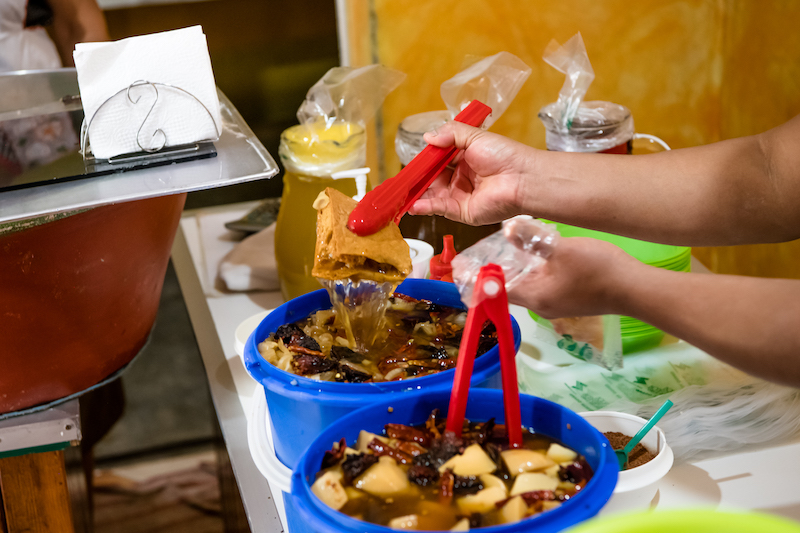
In Oaxaca, a state where gastronomy is almost a religion, there are some extraordinary dishes that are prepared only for special occasions because of the complexity of preparation. Mole chichilo, for example, uses more than 30 ingredients, and its preparation can take up to 3 days. But there are spectacularly tasty (and complex) dishes that can be had anytime. One of these is caldo de piedra (stone soup) from the Tuxtepec region. On our last visit to Oaxaca City, we visited a restaurant a few miles outside of the center whose rendition of this soup blew our minds.

Fonda Pepa

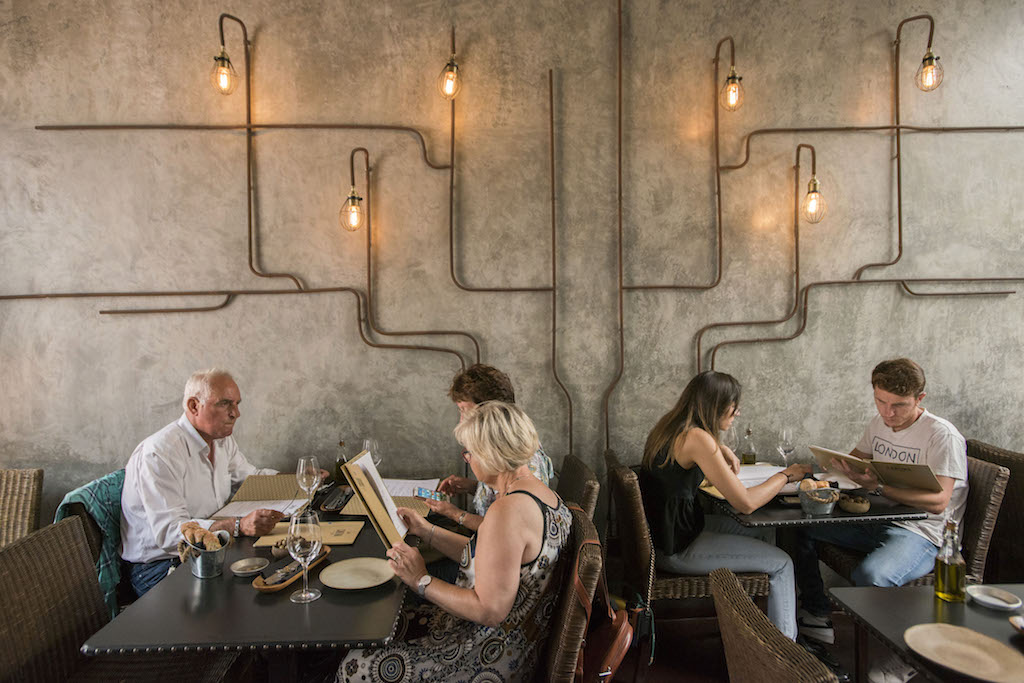
Back in the day, weary travelers in Spain could make a stop at a village fonda, a type of inn or tavern, for a hearty meal and a place to rest their heads. Today, in Latin America, fonda has a more contemporary meaning, including popular restaurants and cantinas serving food and drinks. Both rely on down-home, no-frills fare. But at Fonda Pepa in Barcelona, chefs Pedro Baño and Paco Benítez have taken this concept to new gastronomic heights. The restaurant has the easygoing vibe of a village canteen, with the flavors of a royal kitchen. It was the Covid-19 pandemic that gave the Catalan Pedro and Mexican Paco the last little push they needed to jump into a new personal adventure.

Café (R)égal

Walking inside the bright Café (R)égal, the familiar ingredients of a sustainable restaurant can be seen. Here, a chalkboard lists the local farmers from which foodstuffs are sourced. Each table is topped with cloth napkins instead of disposable paper. A poster on the wall shows the happy chickens that benefit from the kitchen’s compost. All these elements minimize Café (R)égal’s impact on the environment. What makes them unique, is how this conscientious café is also making an impact on people’s lives. Café (R)égal is a restaurant d’insertion, meaning it offers work training to people with disabilities. These apprenticeships provide a much-needed springboard into the workforce and something even more essential: a place where folks of all backgrounds are on the same footing.

Terracotta

Amaghleba Street and its environs stretch like a long arm of the Sololaki neighborhood up into Tbilisi’s hills. The broad main street is lined with 19th-century brick buildings, some of them graced with the magnificent wooden balconies characteristic of Old Tbilisi. At No. 16 sits Terracotta, where a patinaed metal awning hangs over steps heading down into the small, welcoming restaurant and wine bar below. The warm earth tones inside evoke its history as a ceramics studio, and the vases, cups and plates on display are a direct inheritance of Tata Samkharadze, who took over her parents’ art space when they chose to close it in 2018. In its place, she opened a small restaurant a year later with cook Anna Burduli.

Dolcezze Siciliane di Busiello

In Naples, the postale (mail ship) arrives from Palermo every morning and leaves in the evening for the return journey across the Tyrrhenian Sea. Forget about the sensational yet tired connection made between the two cities in the popular imagination – that of the Mafia in Palermo and Camorra in Naples. For us, the postale represents a far more interesting link: The “mozzarella and cannoli connection.” On the Naples-Palermo route, dozens of people can be seen transporting plastic containers holding mozzarella from the Campania region into Sicily. On the opposite route, cannoli and Sicilian cassata (cake) boxes abound. This trafficking of edibles reflects a gastronomic relationship that has long existed between the two cities.

Rengatei

We woke one Sunday craving omuraisu, our favorite Japanese comfort food. Omuraisu, sometimes rendered as omurice, is an umami bomb: a soft egg omelet arranged over rice studded with a protein such as chicken or pork and a flourish of ketchup-laced demi-glace sauce over the top. So we headed to Edoya, a yoshoku outpost in central Tokyo that opened over 60 years ago and became popular thanks to a particularly affable chef. Although it means “Western food,” yoshoku is a decidedly Japanese creation, one inspired by a 19th-century notion of pan-European cuisine. Developed with the support of the Meiji Emperor around 1900, this style of cooking places a great emphasis on meats, often paired with rich demi-glace sauces, which many believed would help Japanese people become larger in build.

Can Calopa - L’Olivera

This may come as a surprise, even to locals, but Barcelona has its own “urban” vineyards and winery. Located inside an old masía (farmhouse) in Collserola Natural Park, a vast greenspace on the edge of Barcelona’s northwestern city limits, the winery – originally a project established by the Barcelona City Council – uses grenache and syrah grapes grown in those vineyards to produce an outstanding full-bodied blend. But more than simply a winery, the project, known as Can Calopa-L’Olivera, is also an effort to provide city dwellers some important lessons about sustainability and the existence of alternative economies. At the same time, it allows agricultural life to make a healing return to the urban sphere, something Barcelona locals started thinking about more seriously during the Covid crisis.

Boza at Damla, photo by Paul Osterlund

Fall often crashes down like a ton of bricks over Istanbul, but it’s a welcome blow. Crisp evenings replace sticky, humid ones overnight. During the day it’s warm enough to walk around in a T-shirt if it’s sunny, though you may need to have a sweater on hand if the sun dips behind a cloud. It was a late afternoon in early October that cemented our deep love for Istanbul. We boarded a ferry from the Anatolian side before the sun set. It was still warm enough to sit outside without a jacket, and the energy of the changing season, both invigorating and soothing, coursed through the air and then our veins.

Maolago

Historically, Guizhou is one of China’s most overlooked provinces. The landlocked location in central China is sandwiched between the famous spice havens of Sichuan and Chongqing to the north and Hunan to the East, and tucked behind the tourist destination of Yunnan to the west. It has the largest population of people in poverty and lowest income per person in China, and the geography of the province has made it tough to travel around; mountainous roads and lack of infrastructure don’t make for easy tourism. Its biggest claim to fame has been Kweichow Moutai (Wade-Giles Romanization of Guizhou Maotai), the famous state-owned baijiu brand served to Richard Nixon when he met Mao Zedong.

Rudy’s Bakery and Café

If we could wind the clock back to 1934, to listen in as Rudy’s Bakery rolled its first strudel, German is the language we would have heard at the baker’s bench, and beside the glass-fronted display cases, and, more likely than not, on the sidewalk outside, along Seneca Ave. At least since the late 1800s, Ridgewood, Queens, was a predominantly German community. Local breweries were major employers; at the turn of the century, Ridgewood and neighboring Bushwick, Brooklyn, were home to more than a dozen.

Modesta da Pampulha

Like many of our favorite Lisbon restaurants, Modesta da Pampulha has very humble beginnings. Originally opened in 1920, the eatery started off as a shop selling charcoal and bulk wine with a simple tavern on the side, evolving over the years to become a temple of homestyle Portuguese comfort food. During the week, office workers from the Pampulha area – between the busy Lapa and Alcântara neighborhoods – along with staff from the nearby Ministry of Education and taxi drivers from a stand just in front of Modesta da Pampulha, gather for lunch in the small restaurant to eat the freshly-made daily specials or charcoal-grilled fish and meat.

Maspindzelo: Hangover Helper Featured Image

We spent our first few years in Georgia in a whirlwind of overindulgence, hostages to the unforgiving hospitality of friends and acquaintances. Try as they might to convince us that their wine and chacha were so “clean” we would not get hangovers, there were plenty of mornings when the insides of our skulls felt like 60-grain sandpaper and our tongues like welcome mats for packs of wet street mongrels. We would hobble out of bed and stumble to the fridge and, if lucky, find two of Georgia’s most recognized hangover remedies: Borjomi mineral water and matzoni, Georgian yogurt.

logo

Terms of Service