
<p><span style="color: rgb(0, 0, 0)">Founded in 1615, Marché couvert des Enfants Rouges is the oldest covered food market in Paris, and one of its most distinctive. This market has produce stands (including organic), cheesemongers, a butcher, a fishmonger, and a flower stand surrounded by some of the city’s busiest restaurants and takeaway counters. There are several covered markets in Paris, but none include options for seated dining. The displays are gorgeous and the scents wafting through the air are hard to ignore. Food options include Caribbean, Lebanese, Moroccan, Italian, Japanese, crêpes and giant buckwheat galettes, and hot dogs and pastrami sandwiches. One of the standouts here is </span><a target="_blank" rel="noopener noreferrer nofollow" class="text-[#781e2a] underline" href="https://culinarybackstreets.com/stories/paris/paris-state-of-the-stomach"><span style="color: rgb(17, 85, 204)"><u>Les Enfants du Marché</u></span></a><span style="color: rgb(0, 0, 0)">, a <em>bistronomique comptoir </em>(counter), serving creative small plates and natural wine. </span></p><p></p><p><span style="color: rgb(0, 0, 0)">Not to be outdone by the restaurants, the fishmonger serves oysters and crudo at the counter, and the butcher offers charcuterie boards, beef tartare, pork chops, and grilled seasonal vegetables. Marché couvert des Enfants Rouges is a lively place, popular among Parisians and visitors alike. Weekdays before the lunch rush tend to be calmer. The market takes its name from the neighboring Hospice des Enfants-Rouges, an orphanage founded in 1535 by Marguerite de Valois, sister of King François I, where the children wore red. The orphanage closed in 1772, and the market adopted the name in its and the children’s honor.</span></p>
The Ultimate Guide to Markets in Paris, Arrondissement by Arrondissement


<p><span style="color: rgb(0, 0, 0)">Marché Saint-Eustache-Les Halles is a small market in the center of Paris. Located in front of Saint-Eustache church, it stands on a site where there has been a market since 1183. The first iteration was primarily a dry goods market, then food stalls arrived and it became Les Halles, France’s largest food market, which was in operation until 1973. This iteration started in 2005, and has about 20 vendors offering fresh fruits and vegetables, fish, meats, cheeses, bread, and prepared foods, including rotisserie chicken, Vietnamese, and African cuisine. A few stalls sell non-food items like carpets, bags, and clothing. On Thursdays, Saint-Eustache-Les Halles is a <em>marché de l’après-midi</em> (afternoon market), open from 12:30 to 8:30pm. Its late hours make it especially useful for lunch and after-work shopping.</span></p>

<p><span style="color: rgb(0, 0, 0)">This small market is located in front of the Palais Brongniart, a grand Neoclassical building (and former home of the Paris stock exchange, built at the behest of Napoleon in the 19th century) that’s worth seeing. On Tuesdays and Fridays, vendors offer produce, seafood, cheese, bread, hot takeaway food, and some non-food items, including clothes, well into the evening, which suits the many office workers in the area. The selection may be limited but the quality is excellent and the Moroccan takeaway is highly recommended.</span></p>

<p><span style="color: rgb(0, 0, 0)">Marché Baudoyer is a charming market in a lovely square behind the Hôtel de Ville (city hall), and a short walk from Notre Dame. This is a small, local market. Even on a sunny Saturday, when everyone in Paris seems to be out, expect a calm and not-too-crowded experience. The vendors are welcoming and offer everything anyone could need for a picnic or a meal: fruit, vegetables, cheese, olives and nuts, fish and seafood, meat, prepared food, flowers, clothing, wine, and more. Marché Baudoyer is open late on Wednesdays, which makes it useful for nearby office workers or a last-minute market run for dinner ingredients.</span></p>

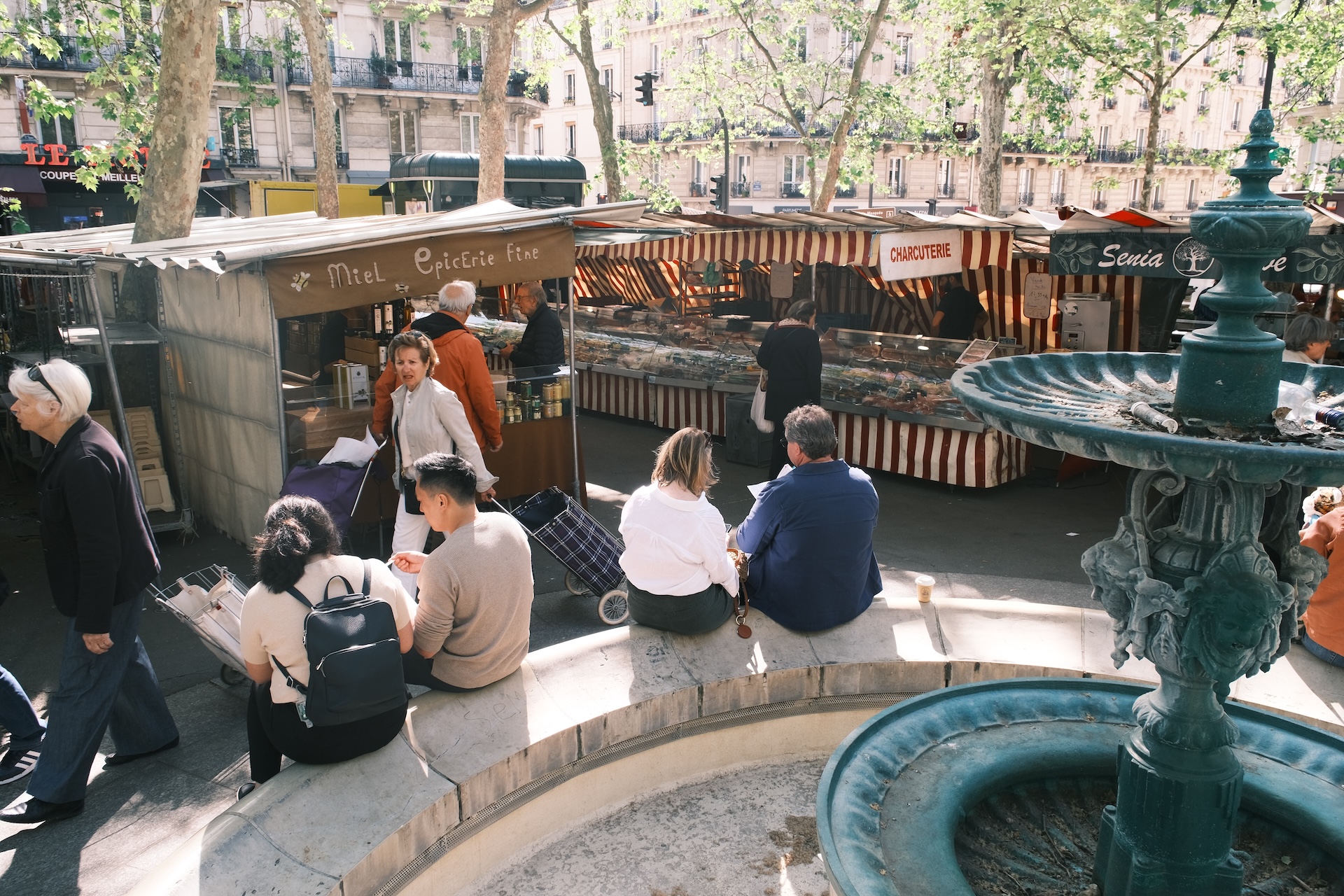
<p><span style="color: rgb(0, 0, 0)">Marché Monge sits in the heart of the Latin Quarter, on Place Monge, a tree-filled square with a fountain in the center just outside the métro station. With around forty vendors, it’s a calm, neighborhood market, where locals routinely line up at their go-to stalls, and kids play by the fountain (or in it, when it’s dry). The location, size, layout, and relaxed neighborhood vibe make this market feel uniquely family-friendly. All the Paris market staples are here, and everything on display is enticing, from the pristine produce and fish to the ultra-fragrant Moroccan stews and rotisserie chickens. There’s a wide variety of high-quality cheeses, meats, bread, prepared foods, honeys, and even some natural wine. There aren’t many non-food items here, but there are flowers, clothing, and, sometimes, furniture.</span></p>

<p><span style="color: rgb(0, 0, 0)">With over fifty vendors, Marché biologique Raspail is the largest organic market in Paris and arguably one of the city’s most beautiful markets. Organic markets in Paris have strictly enforced requirements for vendors, with a focus on sustainability, and tend to have more small producers and market gardeners present. Marché bio Raspail has a large selection of fresh fruits and vegetables, all seasonal and most grown in the Paris region. There’s cheese, fish, bread, meat, nuts, olives, wine, baked goods, and chocolate, which isn’t common at most markets. The selection of hot food and prepared dishes is impressive and ranges from rotisserie chickens to soups, Italian specialties, and various dips, spreads, and salads. Non-food items include flowers, scarves, and cosmetics. For shoppers who arrive hungry, there’s a stall at the Rue du Cherche-Midi entrance selling cheesy potato galettes (a mixture of potato and cheese, griddled like a pancake) that regularly draws a line. There are freshly made crêpes for a sweet snack, and tables in the middle of the market for enjoying oysters. It can get crowded, but it doesn’t feel overwhelming. This market is consistently lovely to walk through. </span><br></p><p><span style="color: rgb(0, 0, 0)">Note: This is not the regular Raspail market, which has a few organic options, and takes place in the same location on Tuesdays and Fridays.</span></p>

<p><span style="color: rgb(0, 0, 0)">Marché Saxe-Breteuil offers the postcard version of a Paris market experience. Brimming with beautiful produce and seafood, it also has a perfect view of the Eiffel Tower. Beyond the produce, seafood, and usual market items, there are specialties like confit de canard from a producer in Toulouse, escargot, olives prepared in every way imaginable, prepared foods like boeuf bourguignon and paella, and a few street food stalls, including a standout börek vendor. Earlier in the day, there are usually rotisserie chickens to take home, still warm and just in time for lunch. There’s a handful of stalls selling non-food items, like flowers, cookware, linens, and clothing.</span></p>

<p><span style="color: rgb(0, 0, 0)">The smallest market in Paris is located next to La Madeleine, one of the city’s most imposing churches. Marché Madeleine, formerly Marché Aguesseau, may be tiny, but the five friendly vendors have all the bases covered with high-quality fruit, vegetables, seafood, charcuterie, flowers, and regional products like honey and chèvre. It’s a charming and efficient shopping experience.</span></p>

<p><span style="color: rgb(0, 0, 0)">Marché Anvers is on the border of the 9th and 18th arrondissements. At the foot of the hill of Montmartre. It’s a smaller neighborhood market, with about twenty vendors who exclusively sell food – produce, fish, rotisserie chicken, meat, cheese, and artisanal products, including award-winning honey. It stays open late, so after the daytime rush, the after-work hours can get a bit busy with all the local regulars shopping on their way home.</span></p>

<p><span style="color: rgb(0, 0, 0)">Marché couvert St-Martin is one of the city’s thirteen covered markets. These are open “daily,” which, in Paris, means Tuesday to Sunday. Originally built in 1854, and most recently renovated in 1980, this market has been providing residents of the 10th arrondissement with fresh foods and specialty ingredients for over a century. Fourteen vendors occupy Marché couvert St-Martin, each with its own specialty or focus. There are organic produce, meat, seafood, cheese, wine, German and Spanish specialties, along with Thai, Italian, Moroccan specialties, and more.</span></p>

<p><span style="color: rgb(0, 0, 0)">Marché Bastille feels like the largest outdoor market in Paris. Across the street from Place de Bastille, and with the Colonne de Juillet as a backdrop, around one hundred vendors form three lengthy shopping aisles down the center of Boulevard Richard-Lenoir. Here, marketgoers can find a wide range of offerings that come in an equally wide range of prices. There are several stalls filled with mounds of fresh produce, with vendors calling out items and offering samples to passersby. There are eggs, cheese and all types of dairy products, meat, fish, and shellfish galore; charcuterie, olives, nuts, dried fruits, fresh juices, jams, honeys, salts, spices, and so much more. The ready-made food options include crêpes, falafel, paella, Indian, and Lebanese, and there’s no shortage of places to sit and eat market finds. And there are always fresh oysters to be enjoyed, shucked to order and brought to diners at a standing table – many markets have one oyster seller offering this; Marché Bastille has three, and some offer wine. The atmosphere is lively, and the various street musicians make it even more eclectic and fun. The selection of non-food items is exceptionally large and includes clothing, shoes, bags, scarves, decorative pillowcases, linens, posters, cookware, handmade soaps and candles, and of course, flowers. A visit to Marché Bastille can feel like an adventure, even for locals. It’s crowded and loud, especially on a Sunday, but always convivial. Thursday mornings tend to be a little calmer.</span></p>

<p><span style="color: rgb(0, 0, 0)">Marché Aligre, also known as Marché découvert Beauvau, is open daily except Monday, and offers a kind of 3-in-1 experience. It’s just outside the Marché Couvert Beauvau, a covered market in a beautiful building that’s over 200 years old. Between the two, shoppers are spoiled for choice in every category. The open-air market is fun and lively, and dominated by produce, with vendors offering samples and calling out special deals on items as people walk by. Next to that is a flea market. In the covered market, there are meat, cheese, seafood, charcuterie, pâté, oils, condiments, spices, tinned fish, Italian specialties, coffee and tea, and more. For anything the market doesn’t have, there’s Épicerie Sabah next to the entrance of Marché Aligre.</span></p>

<p><span style="color: rgb(0, 0, 0)">Marché Auguste-Blanqui is one of the largest markets in the city. On Sundays, over one hundred vendors line up along a sidewalk on a hill – it’s not steep, but there’s a gentle incline as shoppers make their way from the Barrault entrance to Place d’Italie. Conveniently, one of the stalls near the entrance sells coffee, so marketgoers can sip caffeine as they stroll upward; starting from the opposite end means missing the coffee stall. Marché Auguste-Blanqui offers a wide selection of everything Parisian markets offer, from produce and raw ingredients to prepared foods to pastries, including seasonal fruit tarts and classic cakes from Moelleux et Fondants, at notably affordable prices. As all markets in Paris do, this one has several vendors that specialize in foreign cuisines, including Tibetan, Polish, and Chinese, and the made-to-order fried rice tends to draw a crowd. Non-food items include kitchen linens, bags, leather slippers, and sweaters made in the Pyrenees. The Sunday market gets very crowded, so early hours are best for a quieter visit. The weekday markets are slightly smaller and tend to be more mellow.</span></p>

<p><span style="color: rgb(0, 0, 0)">Marché Edgar-Quinet is tree-lined and picturesque, in front of the Montparnasse Tower. It’s a larger market but the friendly familiarity between vendors and shoppers, which is especially palpable here, makes it feel like a tranquil neighborhood gem. There’s a vast selection of the usual market items – produce, cheese, meat (cooked, raw, and cured), seafood, honey, breads, and baked goods, including breads and sweets from Ma Mie Est Chaud – and a diverse range of hot food and prepared dishes to take home or enjoy on site, including cornflake-crusted crispy chicken. The range of non-food items is equally broad, with clothing, shoes, bags, jewelry, decorative pillowcases, beeswax candles, and more. The market is also surrounded by cafés with lovely terraces, perfect for pre- or post-market coffee or lunch.</span></p>

<p><span style="color: rgb(0, 0, 0)">Marché Grenelle is a large neighborhood market with about sixty vendors. It’s in an ideal location for two reasons: first, it’s under an aerial métro line, which means shoppers aren’t hindered by rain. Second, it’s close to the Eiffel Tower. It doesn’t have a view like Marché Saxe-Breteuil, but it’s a short walk away. Marché Grenelle is also not as fancy as Saxe-Breteuil, but many Parisians who live in the 7th arrondissement come here because it has a wide selection of high-quality produce, fresh herbs, and flowers along with cheese, seafood, meat, breads and baked goods, spices, and various artisanal products at very good prices. The atmosphere is comfortable and friendly, a little more local than some of the more visitor-heavy markets. Street food options include corn dogs and crispy chicken. The usual non-food items can be found here, but something notable is the occasional selection of cookbooks at the market entrance.</span></p>

<p><span style="color: rgb(0, 0, 0)">Marché Président Wilson is one of the loveliest Paris markets. Located in the posh 16th arrondissement, surrounded by museums like Palais de Tokyo, Musée d’Art Moderne, and Palais Galliera, and a short distance from the Eiffel Tower, it is certainly one of the city’s most upscale markets. Known for having top-quality products, with several small growers and producers present, it’s no surprise that Michelin-starred chefs shop here. All the usual market offerings can be found here: fresh produce, raw ingredients, prepared foods, wine, baked goods, and various international specialties, including North African, Lebanese, and Italian, along with artisanal products and spices. Non-food items include cashmere sweaters and jewelry. Marché Président Wilson is popular with visitors, and vendors are particularly welcoming and ready to provide a memorable experience.</span></p>

<p><span style="color: rgb(0, 0, 0)">Marché biologique des Batignolles is the second-largest organic market in Paris. Beloved by locals, and full of small farm-to-market growers, this market has a calm atmosphere and an almost village-like charm. Many of the growers and producers from the Raspail organic market also have stalls here, so the lineup of products is quite similar – it’s heavy on beautiful seasonal fruits and vegetables, and there are also wild-caught fish, grass-fed meat, cheese, bread, pâtés, cured meats, honey, jam, and all the other standard Paris market items. Some standouts are the Sardinian specialties and the wine selection. Non-edible items include flowers, soap, cosmetics, and essential oils.</span></p>

<p><span style="color: rgb(0, 0, 0)">Marché Barbès is famously the market to go to for produce at unbeatable prices. It’s also known for its wide selection of fresh herbs, spices, and ingredients that are commonly used in African and Middle Eastern cuisine. Of course, all the French market classics – breads, meats, seafood, cheese, olives, and more – can be found there, too. This is not the place for a leisurely stroll in a postcard-perfect setting; it’s a vibrant market with a dynamic multicultural atmosphere, offering a glimpse of Parisian life most visitors don’t see. It’s popular among locals and gets very crowded when it’s in full swing, so early arrivals are best for anyone who prefers less of a crush. Like Marché Grenelle, Marché Barbès is situated under an aerial métro, so there’s always cover on a rainy day.</span></p>

<p><span style="color: rgb(0, 0, 0)">Marché Place des Fêtes is a spacious market with about seventy vendors. Located in a square with a playground and plenty of cafés nearby, it is known for its warm atmosphere, and is a favorite among locals, particularly families with children. The selection is wide and includes everything expected at a Paris market: rotisserie, meats, cheeses, pastries, honey, and various regional specialties. Regular shoppers often mention the quality of the fresh fish and produce and the fair prices, and the Maghreb sandwiches are a notable specialty. Flowers, textiles, and many other non-food items can also be found here. The relaxed vibe, wide walkways, and surrounding shops and cafés make Marché Place des Fêtes well suited to a leisurely Sunday stroll through the neighborhood.</span></p>

<p><span style="color: rgb(0, 0, 0)">This might seem like a cheat because a map will tell us Marché Belleville is in the 11th, but it also straddles the 10th, 19th, and 20th, and this is the neighborhood market of Belleville, which is in the 20th. This market has been in operation in the same location since 1860, when Belleville was annexed by Paris. It’s one of the largest in the city and known for having some of the lowest prices, along with Marché Barbès. It has a distinctly local feel, though anyone looking for a tranquil market atmosphere may find it overwhelming. Marché Belleville is crowded and bustling, with a friendly atmosphere, and the diversity of the neighborhood on full display. There are all the traditional French market products here, along with Asian, African, and Middle Eastern ingredients and specialties, from spices to produce to takeaway meals. Non-food items include household goods and clothing.</span></p>


