Latest Stories

Ben’s Best

Jay Parker, the owner of Ben’s Best in Rego Park, is a third-generation deli man. Born in 1951 and raised in the nearby Queens neighborhood of Fresh Meadows, he first worked at the family business in the early 1960s. Since 1984, when he took the reins, he’s clocked 60 to 70 hours a week. Yet “this is my dad’s store,” Jay tells us. “His name is still on it.” Not far from where we sit in the dining room, a portrait of Ben Parker looks on, as if in agreement. Ben’s Best is a kosher delicatessen, an increasingly rare business model even in New York. A kosher deli adheres to Jewish dietary laws (by serving, say, corned beef on rye but not ham on rye) and operates under rabbinical supervision (otherwise it would be merely “kosher-style”).

A watercolor of a tomato, image courtesy of Amedeo Colella

Spring means a rebirth, a restart and, for Catholics, a resurrection. The sunnier weather and warmer temperatures are invigorating, allowing you to shake off the long and cold winter. It’s one of the best mood boosters out there. But the season alone doesn’t fully awaken, ahem, everything. If you’re looking to arouse your sensuality, you can always count on Naples’ notoriously stimulating, almost erotic gastronomy. Yes, we’re talking about aphrodisiacs. The concept comes from our Greek ancestors, who believed that certain foods were capable of improving sexual performance and accordingly named them after Aphrodite, the goddess of love, beauty and, perhaps most importantly, pleasure.

Fluffy Espumillas in Queens

It may look like ice cream at first glance, but this street vendor in Queens is selling a different kind of sweet treat: espumilla. The Ecuadorean dessert is an unbaked meringue normally sweetened with guava puree and served in cones topped with a tart berry syrup, , a nice contrast to the extra sweet meringue.

Spring Surprises

It was the first of April and an absolutely pristine Istanbul spring day, the kind where one can break a slight sweat walking up a hill then catch a cool breeze in a nearby patch of shade. Returning to the city from a lovely weekend on Büyükada, we were smitten with spring and wanted to indulge in its finest offerings. In a fit of hunger-fueled inspiration, we quickly realized what we were craving: yenidünya kebabı. This spring-only affair is a specialty from southeast Turkey’s Gaziantep where chunks of minced beef and/or lamb are skewered in between sections of newly arisen yenidünya, or loquat, diminutive orange fruits that are as tantalizingly tart as they are sweet.

Spring Surprises

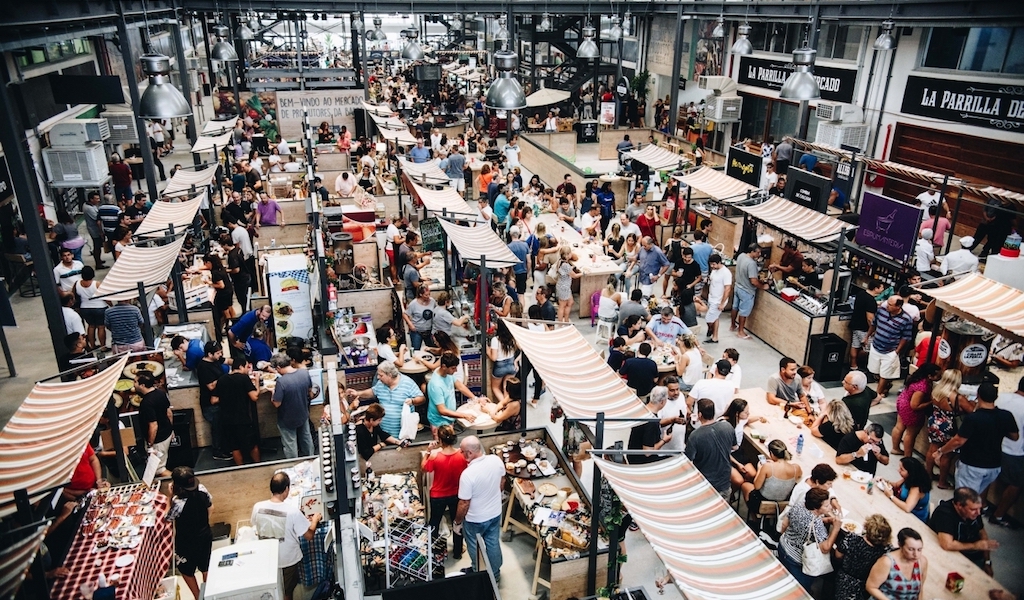
It’s no easy task handling a 70-kilo longfin tuna or a 20-kilo corvina. But over the past few weeks, we’ve watched our favorite fishmongers in Lisbon’s Mercado da Ribeira do just that – looking more like weightlifters or wrestlers, they endeavor to fillet the big, fat Atlantic fish that usually make their appearance in April. Even more humble specimens, like mackerel, are also at their fattest (and tastiest) come spring. That’s the joy of feasting on spring fish and seafood in Portugal – so much is in season that you can’t go wrong. To get a better sense of this spring’s “gifts from the sea,” we visited some of our favorite chefs to learn about how they are building their menus around seasonal fish and seafood.

Spring Surprises

Springtime in Greece brings an abundance of fresh produce. Local farmers’ markets erupt with joy at this time of year – in addition to the cheerful vegetables, herbs and beloved wild greens from different regions, the farmers (already sunburnt) shout out to customers with voices that show a clear pride in their harvest. Perhaps our favorite spring crop is the artichoke, a vegetable (technically a flower) that has been widely consumed by the Greeks since antiquity. The artichoke plant doesn’t usually grow over a meter high, and the most scrumptious part is the unopened bud (when it does bloom, the bud grows into a beautiful purple flower resembling a milk thistle).

Spring Surprises

Flowers may be a visual treat, but they are also a regular ingredient in the cooking of numerous cultures. It’s not uncommon to find roses, violets, orchids, chrysanthemums or any number of flowers – more than 200 in the world are catalogued as edible – adding a pop of color or a surprising flavor to a dish. Flowers have particularly deep roots in Spanish cuisine. They featured most prominently in the food of Al-Andalus, the territory of southern Spain governed by Muslims during the medieval period. Influenced by the Arabs, Andalusian cooks used rose and azahar (orange blossom) to aromatize water and make syrups, jams and pastries.

Spring Surprises

Being the geographic dead center of the country, Mexico City is the hub for all produce heading in any direction. In other words, all roads lead to the sprawling Central de Abastos, the distribution center and wholesaler in the south of the city. “Spring” here is the dry season – the temperatures get hotter by the day until May, even June, when the rainy season begins – but conventional produce is always in season somewhere in Mexico, no matter how parched Mexico City itself might be. But say you’re looking to stick to a “100-mile diet” – surrounding the city there are fertile soils of volcanic valleys as well as high desert regions. So what surprises do they offer in spring?

Spring Surprises

For 48 weeks out of the year, Meijiawu village is pretty quiet. But in the weeks before and after Qingming, the Tomb Sweeping Festival held every year in early April, the tea terraces looming over the town come to life before sunrise. Tea pickers sweep through the fields, collecting the first buds of the season by hand. These emerald slivers will make up the bulk of the farmers’ annual income, although several more harvests of lesser leaves throughout the year will supplement them. Like wine from Bordeaux, Dragon Well (龙井 – Lóngjǐng) tea comes only from the hills near Hangzhou (although in China, counterfeit leaves – like bottles of Château Lafite – are everywhere). Meijiawu village (梅家坞村) is just a short drive from the actual Dragon Well (or “Longjing”) Village.

Farewell, Pando

It’s Saturday around lunchtime and business as usual in the bustling Beşiktaş Çarşı neighborhood, as crowds of mostly younger people fill the narrow streets. Down on Mumcu Bakkal Sokak, a pedestrian-only street lined with miniscule shops, a line around the block has been formed by those eager to get into one of the city’s best döner spots. For many of those waiting in line, however, it’s impossible to ignore the scaffolding-covered building just across the way. Though the scaffolding masks most of the historic building, it’s still possible to make out strips of the distinctive baby blue color of what was one of Istanbul’s most beloved eateries: Pando’s kaymak shop.

Pennette with Genovese sauce at Trattoria Malinconico, photo by Gianni Cipriano and Sara Smarrazzo

If you were to ask me what my ideal lunch is, I would answer without hesitation: paccheri alla Genovese with a large piece of stewed veal shank for the first course, followed by a big ball of buffalo mozzarella (preferably from Tenuta Vannulo, an organic buffalo dairy in Capaccio) with eggplant parmigiana on the side. The backbone of this perfect meal is the Genovese, a simple yet miraculous sauce made of meat (veal, beef or pork) and a heap of onions (red or white). Even those who say they don’t like the taste of onions are forced to recant once they taste the Genovese (after hours spent simmering with the meat, the tenderized and translucent onion slivers have no trace of the astringent smell or bite of raw onions).

Lambrinaki

Today a residential neighborhood four kilometers north of downtown Athens, Galatsi was once comprised of endless fields where shepherds grazed their flocks. Until the mid-19th century, this area at the foot of the Tourkovounia hill range was uninhabited – the shepherds had free rein. All that changed some 150 years ago when the hills began to be quarried for building materials, particularly lime; workers at the lime kilns eventually became the neighborhood’s first residents. But the local shepherds didn’t immediately pack up and leave. In fact, according to one local legend, they inadvertently gave the new neighborhood its name. To sell their milk to the recently arrived residents, the shepherds would roam the streets shouting “Gala, gala, fresko gala” (Milk, milk, fresh milk). It was this constant cry that supposedly led people to call the neighborhood Galatsi.

Tasca Tables

Most tascas’ walls are covered with tiles, framed family or hometown pictures and soccer teams’ scarves. But inside A Provinciana, located between the neighborhoods of Restauradores and Rossio, the main decorative objects are dozens of original handmade wall clocks. Some work, some don’t, but all have great meaning for Américo, the owner of this establishment that has been around for 70-plus years. “I built them. All of them. Every Sunday, our day off, I sit at my house building these clocks with what I have: old tiles, bits of wood, pieces of barrel,” he says, glancing proud at his creations.

Bağdat Ocakbaşı

Istanbul’s T1 tramway is relatively pleasant if you can find a seat, but borders on unbearable if you are on your feet. Back in 2015, we wrote about a trip we took from the line’s first stop all the way to one of its last, which lies way out in the district of Güngören. By the time the tram has made it to this point, it begins to perplexingly share a lane with traffic, voiding the whole point of this type of public transportation. On one weekday evening, we found ourselves standing in a rather contorted position on the beyond-crammed train, a price we were willing to pay for a trip to one of our favorite culinary hotspots. The journey took over an hour. It was well worth it.

Ypovrichio

Despite the somewhat rundown, seedy feel of Omonia today, for all of the 19th century and a good part of the 20th the neighborhood was the real center of downtown Athens. “No one lives in Athens if he does not spend at least one hour a day in the Hafteia,” wrote the famous writer and playwright Gregorios Xenopoulos in 1913, referring to the blocks around the intersection of Aiolou and Stadiou Streets, so named allegedly after a 19th-century café in the area owned by a Mr. Haftas. The area was a commercial hub, filled with stores, coffee and sweet shops and hotels. It was a place where people would come to shop and while away the day or the evening. Given its popularity, it’s no surprise that Athens’ first large department stores, like Lambropoulos and Katrantzos Sport, opened here in the early 20th century.

logo

Terms of Service