
<p><span style="color: rgb(0, 0, 0)">The <strong>trigona</strong> at Elenidis has been made according to the same recipe since 1960, and that recipe has never been shared. The result: a triangular nest of phyllo doused in syrup to the precise threshold between crunch and give, filled to order with a cream dense and velvety without being heavy, fragrant with vanilla and milk. Because the cream is added at the moment of serving, the pastry stays crisp; many pastry shops put filled triangle pastries into the case, where they get a little wet and the pastry loses its flake. This is the difference, in practice, between a good trigona and the best one in the city.</span></p><p></p><p><span style="color: rgb(0, 0, 0)">Elenidis has three locations across Thessaloniki, and in a city where the trigona debate is taken as seriously as the soutzoukakia debate, which is to say very seriously, it tends to end the conversation. It is best eaten immediately; this is not a dessert that benefits from waiting.</span></p>
The Essentials: Where We Eat in Thessaloniki, Greece


<p>This shop was opened in 1928 by Kostis Vairlis, an Asia Minor refugee who brought with him a style of <strong><em>soutzoukakia</em></strong><em>,</em> a spicy tube-shaped meatball from Smyrna, unlike anything the city had tasted: no sauce, no filler, just ground beef kneaded persistently and grilled over charcoal. For decades, its tables were where major deals were struck on the sidelines of the Thessaloniki International Exhibition and where Faye Dunaway once slipped in unrecognized. The shop closed in 2010, but the great-grandchildren of Kostis Vairlis reopened the store in early 2026, bringing the original recipe to a new space in downtown Thessaloniki.</p><p></p><p>Grab a seat that faces the grill, and watch as each piece is watched and painstakingly turned over the coals. When they’re placed on the plate, they get a dollop of mustard and an artful arch of <em>bukovo</em>, or red pepper flakes. You can order it with a side of house-made Rusiki <em>salata</em>, bread, and fried potatoes, so you can build your perfect plate out of a minimal menu.</p>

<p><span style="color: rgb(0, 0, 0)">Dimos Kaloudis learned the art of <strong><em>bougatsa</em></strong> – Thessaloniki’s iconic phyllo pie – from his cousins, finished his military service, and opened his workshop in the Triandria district in 1979. Over the decades he refined the family recipe into something precise: a cream sweet without being cloying, and a phyllo sheet so thin it’s stunning that it’s made so perfectly every time. Those two elements – expertly calibrated sweetness and a flour that is flavorful but balanced – are what have kept people coming back for nearly fifty years.</span></p><p></p><p><span style="color: rgb(0, 0, 0)">In a city where the <em>bougatsa</em> debate is taken with genuine seriousness, O Dimos does it exactly right. No elaborate variations, no seasonal specials, just <em>bougatsa,</em> made as perfectly as possible.</span></p>

<p><span style="color: rgb(0, 0, 0)">Since 1977, Tasos has been stopping Thessaloniki in its tracks, first with profiteroles widely considered among the best in the country, and then with his <strong><em>armenonville</em></strong>, which has achieved a similar reputation through similarly uncomplicated means. The dessert itself consists of frozen cream, meringue, and crunchy almonds. What really makes it stunning is the texture: fluffy and light, sweet but airy, even when drizzled with chocolate sauce. </span></p><p><span style="color: rgb(0, 0, 0)">The<em> armenonville </em>is one of those sweets so specific to Thessaloniki that it could almost be an icon on a postcard, right there with the White Tower and the Paralia, and Tasos's version is the standard against which all others are measured. One bite is, as regulars will tell us, sufficient to understand what the fuss is about. Further confirmation comes from the line outside.</span></p>
<p><span style="color: rgb(0, 0, 0)">Dinos Ballis played professional football for local Greek teams Aris (from Thessaloniki) and AEK (from Athens) before his father-in-law, a tripe master from Drama, persuaded him to open a shop in Charilaou serving just <strong><em>patsas</em></strong>, a hearty tripe soup that is often considered a go-to hangover remedy. He had no experience, so he did what he knew from sport: showed up every day and learned through practice. His son Andreas, who gave up a basketball career after injury, took over the kitchen and brought the same disposition: patient and meticulous about this dish. There are perhaps three or four serious <em>patsas</em> shops left in Thessaloniki, down from forty. Ballis is among the last standing.</span></p><p><span style="color: rgb(0, 0, 0)">The cauldrons sit on bricks over a fire, keeping temperature steady so the tripe thickens slowly, as it should. The shop runs through the night into early morning, serving waiters off shift, taxi drivers, and grandparents with their own precise orders from a vocabulary of variations. Even if tripe isn't our thing, the <em>magiritsa,</em> a soup made of lamb offal that we typically see around Easter, is extraordinary, and the <em>youvarlakia</em>, a sort of meatball made of ground meat, rice, and seasonings, are among the best in the city.</span></p>
<p><span style="color: rgb(0, 0, 0)">Sakis Koultoukis has been cooking in the same small kitchen in the Asia Minor refugee neighborhood of Kordelio since 1966, over a wood-fired oven built to monastery specifications that he starts at five every morning. Five or six dishes rotate daily, including giouvetsi (a red sauce pasta dish topped with a hunk of chicken, lamb or beef), baked beans, <em>youvarlakia</em>, and braised veal, at four to six euros a portion. His beans, slow-cooked for four to five hours, are by general agreement the best in Thessaloniki. He learned to cook on merchant ships and brought what he learned home, refining every recipe over decades without ever raising his prices to match. He cooks alone; his wife Nina handles everything else. When they're gone, he says, we won’t find food like this in Thessaloniki at any price. We think he is probably right.</span></p>

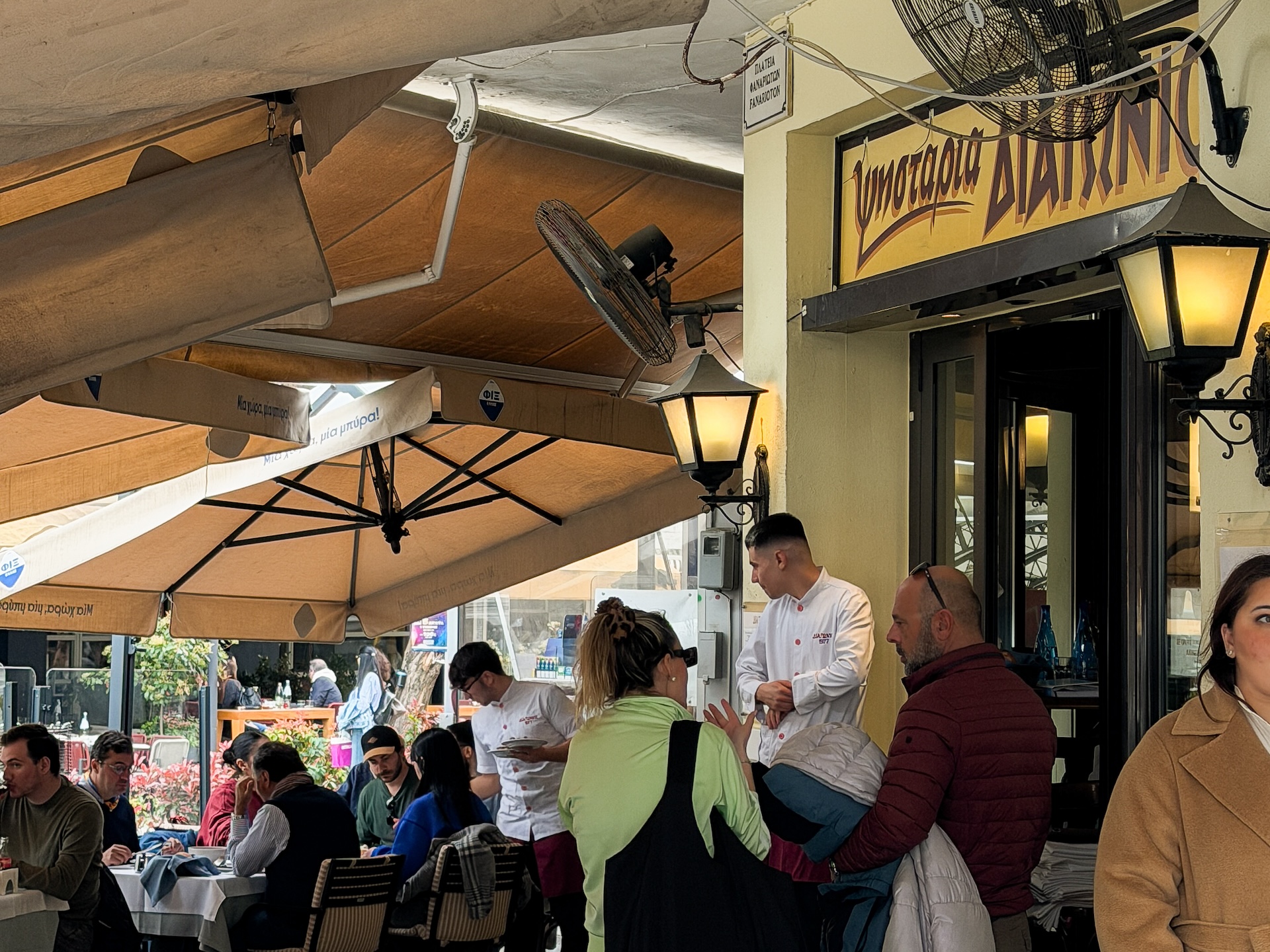
<p><span style="color: rgb(0, 0, 0)">Diagonios opened in 1977 two steps from the White Tower and has not meaningfully deviated since. The waiters are uniformed; when guests rise from the table they come to pull their chair and help with their coat. The <strong>gyros </strong>meat is hand-cut from pork, seasoned only with salt and onion, marinated overnight, and grilled precisely. </span></p><p></p><p><span style="color: rgb(0, 0, 0)">Thessaloniki takes classics seriously, and Diagonios has earned its place not by reinventing anything but by refusing to let standards slip. Not through a change of ownership, not through the crisis, and definitely not through decades of trend and counter-trend. The gyros, the <em>soutzoukakia</em>, and the Russian salad are the order here.</span></p>

<p><span style="color: rgb(0, 0, 0)">Hamodrakas began as a small seafood café for fishermen on a deserted stretch of beach in Nea Krini. In 1924 it was bought by Leonidas Hamodrakas, an officer returning from duty in Asia Minor who was tasked with resettling refugees in the Kalamaria area. He turned it into a taverna, which then became an institution, and the institution gradually became the reason the neighborhood developed around it. A hundred years later it still sits on the edge of the Thermaic Gulf, its original building preserved by ministerial decree.</span></p><p><span style="color: rgb(0, 0, 0)">The fish here is always fresh and cooked without fuss. The room is not flashy, the menu is not trying to impress, and the view of the Thermaic Gulf does most of the work. Which is exactly as it should be.</span></p>


