Latest Stories

CB on the Road

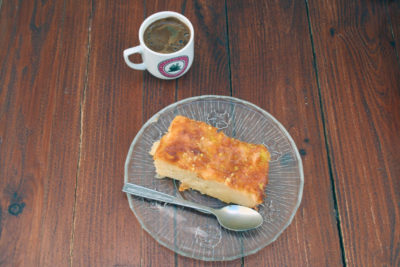
Each morning, 82-year-old Giorgos Chatziparaschos’s bicycle pedals clank and echo down the cobblestone streets of the Venetian-era port city Rethymnon, on the island of Crete. For almost 60 years, he’s parked his bike in front of a 17th-century building where a simple hand-painted sign reveals his family name and his family business. By eight o’clock he has donned his apron and hat, and with the steely determination that underlies his work ethic, he begins to roll out the dough. Chatziparaschos is one of the only pastry makers in Greece specializing in handmade kataifi. The traditional phyllo pastry looks like shredded wheat, with strands as thin as vermicelli.

Mr. Liu serves up large portions of spicy Sichuan food, photo by Jamie Barys

[Editor's note: We're sorry to report that Harbin Dumplings has closed.] Walk along just about any street in Shanghai these days, and you’ll see an ever-encroaching range of Western brands, standardized brand signage and food franchises. As in other rapidly developing countries, the battle for consumer dollars and brand loyalty has meant more chains and mass-produced food. That’s partly what makes stepping into one of the several Liu Family Harbin Dumplings shops a breath of fresh air. Every morning until the lunch rush, the dining room and back rooms are set up with trays and workers dexterously making every dumpling from start to finish. Dumpling wrappers are meticulously hand-rolled, the fillings are mixed in large batches, and the time-consuming process of filling and closing the dumplings marches on until tray upon tray is ready for boiling.

Fonda El Refugio

Fonda El Refugio is a name that you will likely come across when looking at guides to Mexico City. The small restaurant in Zona Rosa, a popular tourist destination, has been serving authentic Mexican food for more than 57 years. Politicians, artists, writers and all kinds of celebrities have dined here over all those decades. Renowned writer Octavio Paz chose this restaurant’s food for his banquet with the Mexican president after receiving the Nobel Prize in literature in 1990. However, in recent years the quality of the food took a turn for the worse, and this iconic restaurant’s reputation took a major hit.

Spicy beef noodle soup at Pang Mei Mian Zhuang, photo by UnTour Shanghai

“Can you eat spice?” the waitress asked after taking our order. Her hand hovered hesitantly over the cash register. “Yes,” we replied. “But... Can you?” she asked again, looking to the other waitresses for help. “Yes!” we responded emphatically, trying to vocally convey our love of the tongue-tingling, lip-burning action we had come for. “Umm... These are Chongqing noodles. They are really spicy,” she said with her hand still in a no-man’s-land somewhere between our money and the cash register, unsure whether our foreign palate had what it took to slurp down a bowl of noodles from China’s spiciest city.

Art Café 144 Steps

The 2010 makeover of Tbilisi’s old town broke the hearts of many locals and preservationists, who lamented the destruction of the neighborhood’s original 19th-century buildings and the fabrication of their cinder block replicas. The quarter hadn’t seen destruction on such a scale since the Persian ruler Agha Mohammad Khan razed the city in 1795. Instead of bemoaning the architectural tragedy, one local artist seized the opportunity to inject some positive vibrations into the precipitous hillside district by purchasing a small house underneath the 16th-century walls of the Narikala Fortress and turning it into one of Tbilisi’s coolest cafe-restaurants. Getting there, however, requires a bit of cardiovascular effort.

Granja Elena

Despite the 1970s-era sign outside that says Granja (farm) and the red letters spelling “Bar” inside, you can’t really tell what this place is until you open the menu: a temple of “neighborhood haute-cuisine.” The food at Granja Elena sounds simple but tastes rich and complex. The restaurant is a family business, now run by the third generation – Borja, Patricia and Guillermo Sierra Calvo – in the same barrio in which it was founded in 1974, La Marina del Port. This modern neighborhood is part residential and part industrial, a bit far from Barcelona’s center, located near the merchant port behind Montjuic and on the way to the airport.

Behind Bars

Urfa's old city is an invigorating array of tones and sounds. Dominated by an intriguing maze of narrow streets, the buildings all share the same sun-baked sandy hue, suggesting that they rose up from the earth on their own centuries ago. Landscape and cityscape blend into one here, and cars are outnumbered by ornately painted motorbikes equipped with sidecars, vehicles perfectly equipped to navigate roads too narrow for vans and sedans. Older men don poşu scarves of varying color combinations, and Arabic is spoken more frequently than Turkish. Believed by locals to be the birthplace of Abraham, Urfa is known as the “City of Prophets.” The municipality proudly advertises this fact.

Ichiran

There are times when food is just so profoundly, soul-satisfyingly good that we find it difficult to divert our attention enough to do the socializing often required when eating out with company. The folks who devised Ichiran Ramen must have taken that into account when they set up shop. Their concept is to offer complete personal space so that customers can give their undivided attention to the Hakata-style ramen served there. Imagine being encouraged to loudly suck up your ramen in the privacy of your own personal counter “booth.” Nobody really knows or cares who’s there, and whatever slurping happens there stays there.

Tacos de Canasta La Abuela

Just a block away from Mexico City’s financial district one unlikely food star sets up shop every morning. From Monday to Saturday, at La Abuela, 72-year-old Arnulfo Serafin Hernandéz feeds hungry office workers, commuters, neighbors, school kids, government officials and tourists from all over the world with one of the simplest Mexican dishes: tacos de canasta. He fries a corn tortilla a little in lard or oil, fills it with one of the prepared ingredients, folds it in half and places it carefully inside a canasta, or basket. He wraps the tacos in cloth and covers them with plastic to keep them warm. This also makes them moist and soft when serving, two of the most important characteristics of a good taco de canasta.

CB on the Road

As one approaches the port of Ermoupolis (named after Hermes, the god of commerce), the main town of the island of Syros and capital of the Cyclades, one cannot help but marvel at its beauty and grandeur. Imposing public buildings and private mansions, marble-paved streets, a large Italian-style piazza and numerous churches make the city one of the best preserved examples of 19th-century architecture in Greece. This should not come as a surprise: in the aftermath of the 1821 Greek War of Independence from the Ottoman Empire, Syros developed into an important commercial, cultural and industrial center, as refugees from Asia Minor, Chios, Crete and other areas found a safe haven from the war on the small island.

Santa Filomena

Like the classic optical illusion of the faces and the vase, look at Rio and you’ll see two sharply contrasting versions. First is the seemingly easygoing beach city of rubber sandals and gushy greetings as insincere as they are well intentioned. (“Passa lá em casa!” “Come by my home!” The carioca will actually be quite stunned if you show up at his home afterward.) On the other side of the illusion is the Rio that loves formality, titles, certificates and hierarchies. A Rio judge has a decade-long lawsuit against the doorman of his building, who refused to call him “doctor” and “sir,” which recently reached Brazil’s Supreme Court, which declined the case.

Tbilisi Sketches

You sit down for a meal with family or friends, and no one can decide what to order. Well, some can, some can’t, and it goes on for ages. The waiter stiffens when you ask one more time for her to come back. But go to the basement restaurant of Shavi Lomi in Old Tbilisi, and you have the answer for dithering relatives and pals: the gobi, or “Friends’ Bowl,” filled with a colorful selection of classic Georgian dishes. The word shares the same root as the Georgian word for “friend” – megobari – and so, of course, a gobi bowl is for sharing. It’s a big wooden bowl, filled with a mix of different dishes and as many spoons as you need.

Asado de obra, photo by Paula Mourenza

In Argentina and Uruguay, asado – beef cooked over a parrilla, or open pit grill – is a fundamental part of local culture. On weekends, Sundays especially, grill smoke can be seen rising from backyards, rooftops and even small balconies, as well as, of course, from restaurant ventilators. Out of town, there are asados in chacras (small countryside farms) and in parks and picnic areas in forests. Asado’s defining role in these countries has existed for quite some time; it was even mentioned by Charles Darwin in his journals from 1833, when he was traveling towards Buenos Aires in the company of gauchos and native people.

Feira de São Cristóvão

Let’s say you have only two or three days in Rio. You want to experience a little real Brazilian culture and don’t want to restrict yourself to the obvious tourist stops, overhyped bars and restaurants or usual “gringo” nightlife spots. Our recommendation? Spend a night or day – or both, even – at Feira de São Cristóvão. The feira, which means “fair,” is organized by people from the northeast (nordeste), which is the poorest region in the country. That poverty has led millions of northeasterners to migrate to Rio over the last 50 years to seek a better life. And Feira de São Cristóvão is where they express themselves culturally, musically and, last but not least, gastronomically.

Tasca Kome

After almost a century of desertification, it’s sometimes hard to believe the state of downtown Lisbon – Baixa – today. Hotels, startups, boutiques and restaurants are exploding up and down these long, narrow avenues, originally modelled on 18th-century Parisian thoroughfares, and all but abandoned by the 1990s. As the few remaining owners of the old light fittings shops and cheap canteens pray to the gods of damage limitation, a few of the new businesses do fit well into the surroundings. Japanese canteen Tasca Kome is one of them. Like all typical Portuguese tascas – traditional taverns and bars that serve food – the atmosphere at Tasca Kome is cozy and friendly.

logo

Terms of Service